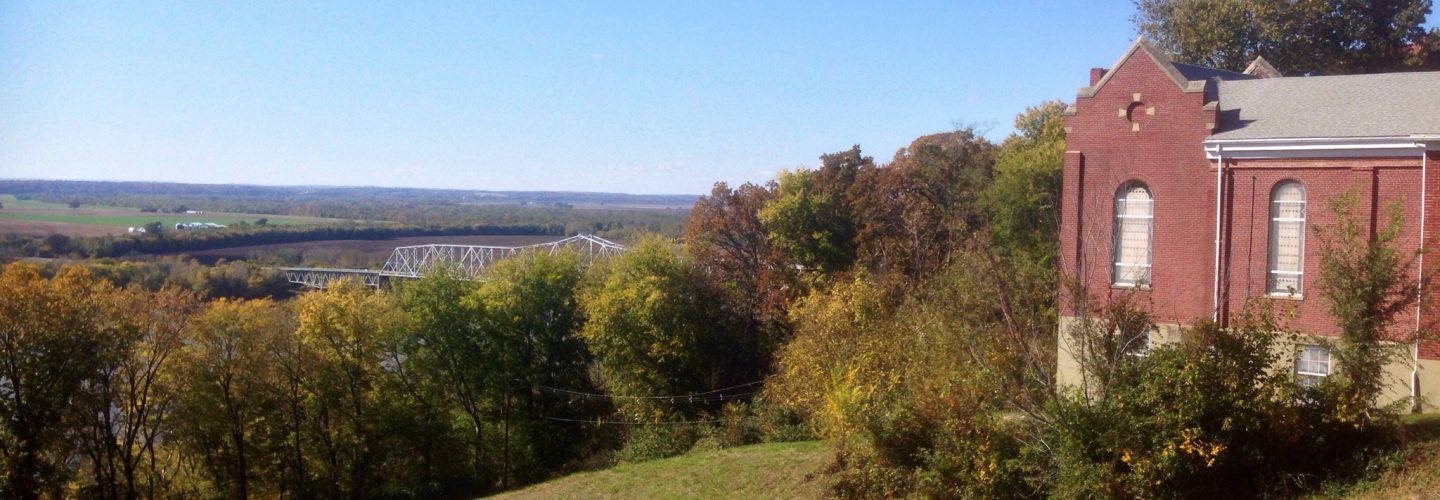

Pioneers in the field of automobile travel, the members of the Burlington Way Committee were dedicated to establishing good roads in Randolph County a century ago, improving travel and bringing traffic to local businesses along the route.
At the turn of the twentieth century, Randolph County’s citizens relied solely on horses, carriages, carts, wagons, and trains to transport them from town to town and farm to farm. The county’s roads were largely made of packed dirt that quickly turned to mud in bad weather, but the pace of life was slow enough—and the challenges of travel such an expected part of life—that the possibilities of innovation weren’t a major consideration.
But then, in 1901, automobiles began slowly appearing in towns across the county. The Chester Tribune recounted the shock felt that year by residents of Coulterville on their first encounter with a gasoline-powered car: “A citizen of St. Louis drove down from the city to Coulterville last week on a visit to friends in that place. The vehicle driven was an automobile, and the people of Coulterville were greatly exercised over the coming of the strange creature into their midst.” The excitement didn’t quickly dissipate. In 1905, the Tribune recounted another local vehicular first: “The first automobile seen on the streets of Steeleville created a great deal of interest last Saturday. The machine was a most elegant tonneau and belonged to a citizen of Pinckneyville, one of the proprietors of the new store at Percy.”
Sightings of automobiles continued to be few and far between for several years, thanks to the various difficulties with operating them in the area. A story from the Red Bud Pilgrim in November 1901 illustrates many of the issues: “Dr. William Bahrenberg of Belleville has an automobile. Last Sunday he concluded to make a trip to Baldwin to visit relatives and to make the trip in his horseless carriage. He started and got stuck in the ‘sand road’ near New Athens and had to get help to get the machine out on better road, but made the rest of the trip to Baldwin all right enough. Coming back he met a farmer whose horses tried to climb the telephone poles at the sight of the strange monster and the Doctor shut off steam and ‘slammed on the air’ as it were; after the team had passed, Doc yelled ‘get up,’ but the auto refused to budge; he yanked all levers, but still the machine was a corpse, to all intents and purposes. Now when a horse or mule balks you can build a fire under ’em or coax ’em with a fence rail, but it won’t work on an automobile, so the Doctor went to a farm house and hired the farmer to a pair of plain-old fashioned Missouri mules to the outfit and towed the craft safely to Belleville.”
The roads of Randolph County were often difficult to traverse, the horses pulling wagons could easily be spooked, and there were few people in the communities who knew how to operate or repair automobiles, but none of that stopped the craze for “machines” from sweeping through the county. Within just a few years, adventurous citizens began acquiring their own vehicles. The first car owner in Chester was Henry “Butch” Heine, whose 1907 automobile purchase was covered by the Pilgrim: “Butch Heine of Chester has a new automobile, the first one owned in the hill city. If the machine will climb the kopjes of Chester it is a peach. Butch advertises in the local papers that as the auto frightened a few horses and he wants to prevent accidents, if the people who desire him to stop will hold up one hand à la Billy Bryan, he will do so.”

Heine bought his automobile from the Herschbach Bros. of Chester. The family had established a successful wagon factory in the 1870s, and in 1908, they officially expanded their business to offer automobiles, opening the first car dealership in the area. The contract they signed with Ford in St. Louis was advertised heavily in local papers. “Having considered carefully the different makes of Automobiles with a view of handling the best machine adapted to Chester and Randolph County, we have selected the Ford and have secured the agency for this county,” they trumpeted in May 1908. “In a few days we will have at our store samples of different styles. These machines are strictly guaranteed in every respect. If interested, we would like to talk Automobile to you. Our prices will interest prospective buyers.”
The people of Randolph County were definitely interested. Soon enough, gas-powered cars were popping up in barns throughout the area. Some were purchased new through a dealer, while others were more innovative affairs. Charles Baue, a farmer and machinist from Steeleville, was the proud owner of the first car in his village. He “bought the remnants of a defunct touring car from a citizen of Pinckneyville, and combining the remnants with his mechanical genius evolved a very respectable machine which will compare favorably with some driven by the chauffeurs of city millionaires. Charlie is proud of the machine and his friends are proud of him.”
As automobiles became more and more prevalent on the streets of county towns, local government moved to place regulations on their use. Inexperienced drivers of gas-powered cars quickly caused a whole slate of problems, including injuries to people and animals and damage to property. In Chester, the town council established speed limits and handed out fines for racing and dangerous driving. Automobile drivers were required to cede the right of way at all times to horses.
While the vast majority of local citizens continued to depend on horse-drawn conveyances as their primary mode of transportation, it was soon apparent that there were circumstances in which an automobile was a far more beneficial choice. In 1913, the Tribune reported that Charles Baue “found that he could use his automobile to better advantage during the icy weather of last week than he could his teams, so he came to [Steeleville] in his machine on Thursday and Saturday. His horses, not being sharp shod, could not travel the roads, so Mr. Baue wrapped the wheels of his machine with old sacks and chains and came to town.”
Farmers were finding increasing uses for gasoline-powered vehicles in hauling and towing. Many of the doctors in the county were early automobile customers, as the machines allowed them to make the rounds to rural patients more efficiently. Mail carriers, delivery drivers, politicians—numerous citizens were finding reasons to buy into the popular automobile trend. By 1910, Matt Sproul of Sparta opened a second vehicle dealership in the county, selling Maxwells and Buicks, and the city was also home to an automobile garage for fixing damaged and malfunctioning cars.
The biggest obstacle to putting more automobiles on the county’s roads, as many local car enthusiasts saw it, was the roads themselves. Various towns in the county began in the 1910s to transform dirt streets into paved roads, using gravel and macadam to complete the process. With the momentum toward creating hard roads throughout the county and the region, residents saw new possibilities in faster travel. In 1910, a group of Chester citizens made the trip to Sparta in an automobile in an hour and twenty minutes, a major improvement over the length of the same journey in a horse-drawn wagon.
But the lack of pavement meant that those quicker-than-usual trips were only possible if the weather cooperated. Ten years later, on the first nice spring day in April 1920, one Chester motorist “started for Sparta, but found the going so difficult within two miles of Sparta that it was decided to abandon the trip and return to Chester.” The Chester-Sparta road was then one of the most heavily-traveled in the county, and a local road commissioner told the Tribune that ‘the wear of the road on account of automobile traffic [was] inconceivable,” with cars cutting “deep ruts” into the road surface, making year-round maintenance impossible unless the road could be properly paved.
Campaigns to provide that much-needed infrastructure update quickly followed. The Good Roads Movement, a national campaign to divert state and federal funding toward the improvement of rural roads, had been established in the 1870s to facilitate travel by bicycle. In the 1910s, the movement shifted its energy toward making roads fit for the automobile. Highway associations popped up in states across the nation, including Illinois. In 1916, President Wilson signed the Good Roads Act, the first federal highway funding law, offering increased money for roads that would be free to the public. Illinois quickly established a state highway agency to manage the federal funds, and two years later, the voters of the state boosted road funds by approving $60 million in bonds to construct nearly 5,000 miles of hard road highways in Illinois.
But where would the new “good roads” go? As various committees worked to decide the routes that the state highways would take, communities lobbied to have the roads pass through or near their towns. Being located on or near a state highway would bring a significant boost to local businesses and potentially draw tourists, as well as new residents to build houses and pay taxes in the community. With war looming, there was also the promise of military benefits for communities on good roads. Towns on the highway system were better candidates, for example, for training camps for soldiers preparing to fight overseas. The new roads were increasingly marked with signs and numbers that were then published in roadway maps, marketed to motorists to help them navigate the new system of hard roads.

The need for groups and committees to rally for good roads in Randolph County became particularly evident in December 1916, when the Chicago Tribune published an elaborate map of the state’s marked highways. Only a handful of counties in the state were not serviced by a marked highway, and Randolph County was one of them. Several state roads, frustratingly, stopped just short of the county line. The Egyptian Trail, which ran from Chicago to Cairo via Carbondale, stretched out one spoke in Jackson County to Campbell Hill. The Kaskaskia Trail ran from St. Louis through Monroe County, but stopped at Renault. The Cairo Trail stretched from St. Louis through St. Clair County, stopping at Marissa, again just outside of the county’s boundaries.
Movements began swiftly to establish routes that would connect the existing state highways to routes through Randolph County. One of the first was championed by the Burlington Way Good Roads Association. The organization promoted the establishment of a north-south highway that would span the country from St. Paul, Minnesota to the Gulf of Mexico through Burlington, Iowa. The project was promoted heavily by the tenacious Harry Wilhite, a buggy salesman turned car enthusiast from Greene County, Illinois. He traveled extensively on both established and prospective sections of the road, sharing the benefits of being located on a prominent highway with anyone who would listen.
By the spring of 1917, the Burlington Way project had reached the citizens of Steeleville, Sparta, and Percy, who hoped that a new section of the route could make its way through all three towns as it stretched from Marissa to Campbell Hill toward Murphysboro. A “rousing good roads meeting” was held in Steeleville’s auditorium when “a big crowd came over from Sparta with a Sparta drum corps and band” to cheer on the issue. The auditorium was filled to capacity for the meeting, which was held to encourage “enthusiasm in support of the location of the Burlington Way by way of Sparta and Steeleville to Murphysboro and Carbondale.” One of the most passionate speakers on the program was Clara McKelvey, the wife of the county superintendent of schools. She argued that “the great highways to be established throughout the state will be traveled by thousands of automobile tourists yearly, who will bring to each town through which they travel large sums of money.”
The general excitement for the road project was aimed both at attracting attention from the committees making route decisions and at convincing local property holders to agree to have the road built on land they already owned. A committee of local men from various backgrounds was formed to champion the project. Forty-seven-year-old Charles Baue, that intrepid farmer and early automobile enthusiast from Steeleville, was one of the first to sign up to join the group. Baue was always particularly interested in innovation and was known in town as a skilled and inventive engineer. With his wife, Margaret, he had five children, all of whom were living at home on the family farm between Steeleville and Sparta.
Charles was joined in the endeavor by men from different industries, all of which would benefit greatly from the connections offered by the highway placement. Alfred A. Brown, a 58-year-old banker and merchant from Sparta, found the committee work to be a useful occupation as he mourned the recent passing of his wife. Two more Sparta merchants also signed up to be part of the project. William J. Hood, a 46-year-old dry goods retailer, and 45-year-old Louis Hood, who owned a local clothing store, would also benefit greatly from a state highway passing through Sparta.
Merchants from other towns on the proposed path were also interested in the project. John B. Hoef of Steeleville joined the group, eager to promote his marble and granite business, Randolph County Monument Works. The 40-year-old marble cutter lived near the shop with his wife, the milliner Theodosia Scheele Hoef, and their children. Henry Walter, the 51-year-old manager of the Stahlberg Store in Steeleville, was also the state-appointed Food Administrator for the community, and he knew that connection to a state highway was a crucial step forward. Further down the route, 36-year-old George Lickiss of Percy was also keen to be part of the organization. With his wife, Caroline, and their young son, George ran a local grocery store.
Those selling retail goods weren’t the only ones who stood to benefit from the potential Burlington Way route through Randolph County. Albert Gilster, the 45-year-old bachelor owner of a large flour mill in Steeleville, joined the cause. So did the mill’s vice president, 41-year-old Rutherford Hahn. His wife, Maude, had relatives in East St. Louis, so the road connection would also have a personal benefit for the family.
Fifty-two-year-old Norris Lessley also had personal and business reasons to join the committee. As the president of Sparta State Bank, he knew how vital it was to bring new investments to the community and bolster existing enterprises. His son, James, was now running the family farm in Baldwin, and the road might bring further prosperity his way as well. And, above all, Norris was an enthusiastic motorist, serving as treasurer of Sparta’s newly-formed auto club.
In Steeleville, one of the most active members of the community also signed up to be part of the group. J. Hammond Webster, the Kansas-born publisher of the Steeleville Ledger, also had other extensive business interests in the community, including a popular movie theater. The 40-year-old businessman was also the owner and operator of an automobile garage and service station, through which he was a retailer for Hupmobiles.
Two colorful local leaders of the coal industry rounded out the committee’s numbers. Forty-eight-year-old Robert Moffat, known as “Cap,” was part of a family of English transplants who owned and operated the Moffat Coal Company in Sparta. Though coal was then largely transported by rail, better roads would open up new avenues for the company to extend its reach to eligible workers and to new customers. The blustery, brash Thomas Jeremiah, born in Steeleville to a family of Welsh coal miners, was the general superintendent of the Willis Coal Company, which operated mines near Steeleville, Percy, Willisville, and Ava. Forty-nine-year-old Tommy, who spent much of his time at his desk in the company office in Willisville, became one of the most vocal advocates for locating the new road through Sparta, Steeleville, and Percy.
The committee members quickly made themselves visible at Burlington Way meetings across the region. Not long after Mrs. McKelvey’s presentation in Steeleville, they joined numerous interested local citizens in Ava, where Harry Wilhite held an informational meeting about the road. The Chester Tribune noted that Wilhite shared that “the Way is now marked from St. Paul, Minnesota to the Gulf of Mexico, about 2,200 miles.” As committee members traveled to meetings throughout the area, local motorists showed their enthusiasm by gathering in towns along the way. Steeleville’s columnist for the Tribune wrote, “Our citizens gave the Burlington Way location committee a big send off here last Thursday. The streets of town were filled with machines when the committee arrived, and sixty-four machines followed the committee from Steeleville to Sparta, more than forty machines joining the parade before Sparta was reached.”

But the Steeleville and Sparta-based committee wasn’t the only group hoping to locate the newest section of the Burlington Way through their communities. There were rival committees from other potential routes, including one that would run through Tilden, Coulterville, Pinckneyville, and Du Quoin toward Carbondale. The two groups found themselves face to face at a meeting held in the Carbondale Opera House. The Pinckneyville Advocate described a circus-like atmosphere at the gathering. The committee from Steeleville and Sparta “blew in with two brass bands and a big drum corps—and Charley Ritter,” a popular resident of Murphysboro, who led the parade “in a beautiful light grey overcoat. Charley sported a nobby cane with vari-colored ribbons fluttering therefrom and led and directed the parade with charming grace, turning every now and then to wave his cane at his followers, thereby giving the spectators a chance to note [the] fit of his coat in the back.”
The Sparta-Steeleville committee was also prepared with signs and banners pressing their cause. “The Sparta crowd had a banner bearing a map showing Sparta and Murphysboro just outside of the East St. Louis city limits, while Du Quoin was located just two miles west of Cincinnati’s first pretzel factory, which looked to be someways from Carbondale,” the Advocate wrote. Harry Wilhite “spoke and in his talk advocated a time limit of five minutes on each speaker representing each town.” This was protested loudly by some in attendance. Also contentious was the selection of local representatives from each town along the contending branches of the route. Arguments continued, with local committee member Tommy Jeremiah participating with “a full set of verbal pyrotechnics” from his seat in the gallery balcony. With Wilhite unable to restore order, the meeting ended without any decisions, and the debate about the route of the Burlington Way continued.
In the end, the Sparta-Steeleville route won the day. It was decided that the newest section of the Burlington Way would indeed travel through the eastern half of Randolph County, through Sparta, Steeleville, and Percy, before heading toward Murphysboro. Residents of the local towns were jubilant at the news. One Sparta merchant, Sylvester McGuire, even renamed his business the “Burlington Way Shoe Store” to commemorate the decision.
Actually building the road as planned proved more difficult. In 1919, the Burlington Highway received a new name: the Mississippi Valley Highway. As state roads in Illinois were assigned numbers, it became known as Illinois 13. No matter the name or number, progress was slow. A state map of Illinois highways produced in 1925 shows the planned Route 13 running through Sparta, Steeleville, and Percy toward Pinckneyville, but the Randolph County section is marked “no work done.”
In the end, changes to the planned route ultimately took the highway in a different direction. In 1937, the Belleville Daily Advocate reported on several changes to the numbering of local roads. Among these was a rerouting of Illinois 13: “Sparta, which had a hard time routing Route 13 through the city, now loses that route and Route 13 now turns at the Tilden Y and goes east through Tilden, Coulterville, and Pinckneyville and to Murphysboro.” In the end, the Tilden-Coulterville-Pinckneyville won the fight two decades later.
But the work that was done by the members of the local Burlington Way Committee established a precedent for support for good roads in the county, leading to a host of improvements over the decades that followed. “Good roads are a necessity,” the editorial staff of the Chester Tribune declared in 1918, adding, “We cannot do without them much longer.” In 1920, the state decided to locate Route 3 south from Waterloo through Red Bud, Ruma, Evansville, Ellis Grove, and Chester, opting for that route over a different path that would have taken it through Prairie du Rocher. The same year, plans were made to complete a rock road between Percy and Steeleville, with Hammond Webster and George Lickiss also serving on that committee.
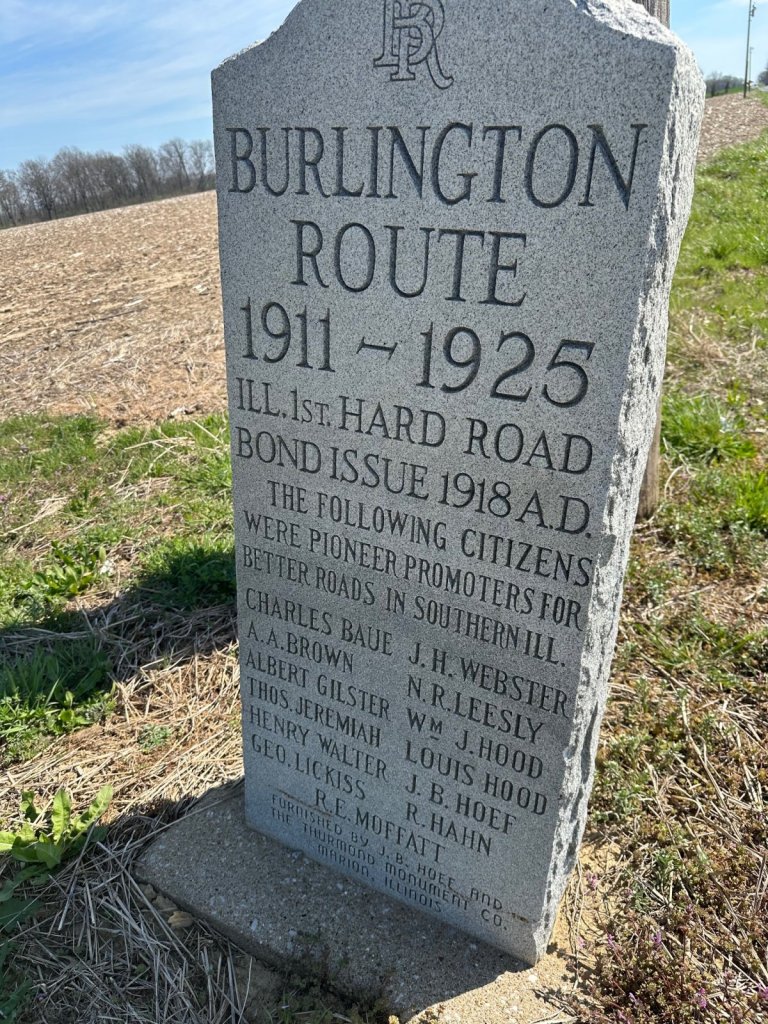
One member of the Burlington Way Committee ensured that, even as the roads of the county changed and evolved, the early work that was done by the group to draw attention to the need for good roads would not be forgotten. John B. Hoef placed a granite monument along the planned Burlington Route (now Illinois 4) in Blair between Sparta and Steeleville, dedicated to the “hard road bond issue” of 1918. The text engraved on the marker reads, “The following citizens were pioneer promoters for better roads in Southern Illinois: Charles Baue, A.A. Brown, Albert Gilster, Thos. Jeremiah, Henry Walter, Geo. Lickiss, J.H. Webster, N.R. Leesly, Wm. J. Hood, Louis Hood, J.B. Hoef, R. Hahn, and R.E. Moffat.”
Today, the issue of “good roads” continues to be at the top of the list for many in the area who want to steer attention toward the maintenance of existing roads and the expansion of highway connections between Randolph County and its neighbors. A century ago, when roads made for automobiles were in their infancy, we can thank the men of the Burlington Way Committee for championing the cause. Their public service is a reminder of the importance of community advocacy, both then and now.
The members of the Burlington Way Committee were inducted into The Randolph Society in 2025.
 The Randolph Society