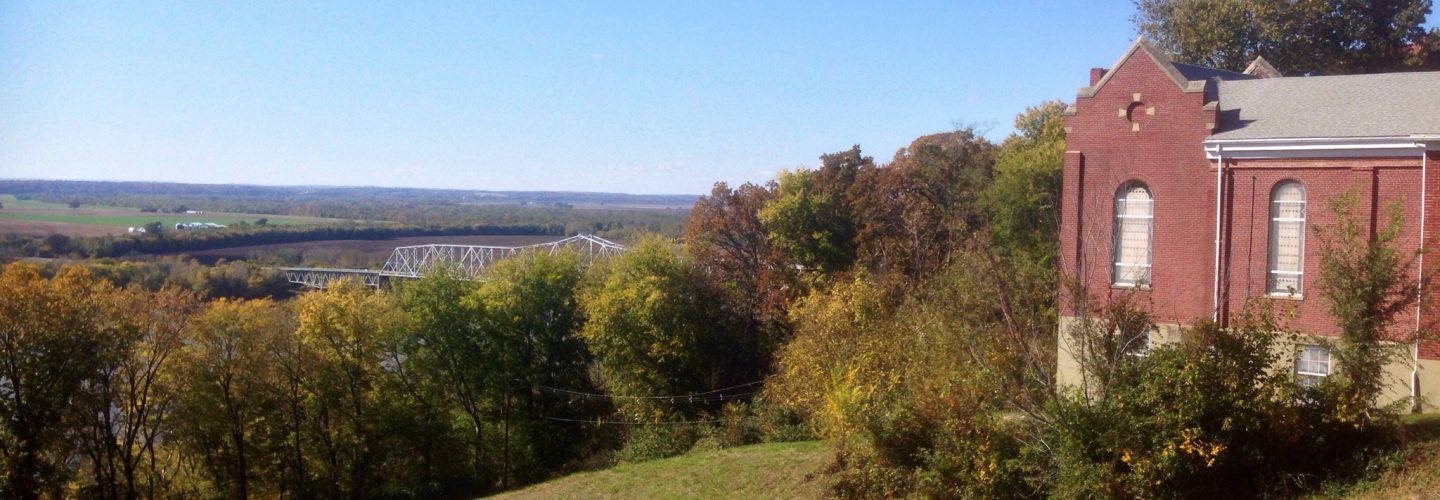
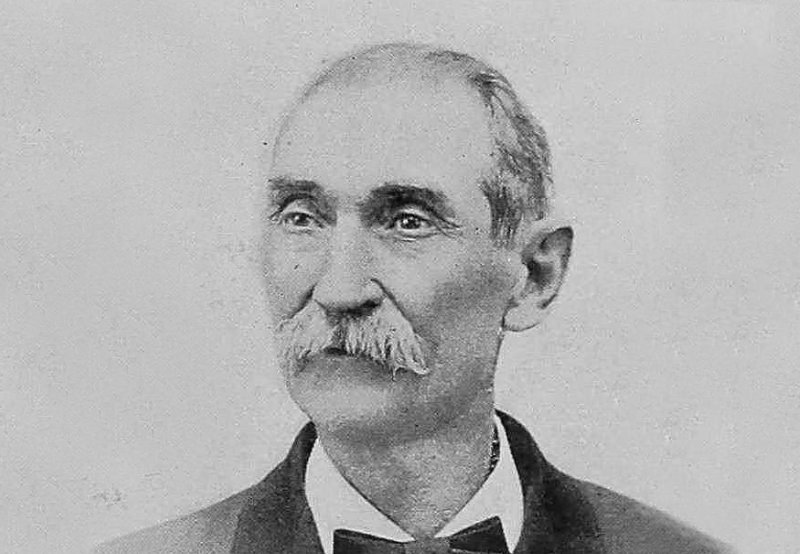
A dedicated educator who served his community and his country valiantly, Samuel Burns Hood laid the foundations for an education system that continues to serve the young people of Randolph County today.
Samuel Burns Hood, the fifth of ten children of John Alexander Hood and Sarah Burns Hood, was born in Chester, South Carolina, on May 15, 1834. Samuel’s father, John, was an Irish immigrant from Antrim, and his mother’s parents were also from Ireland. Much of Samuel’s childhood was spent in the rural part of northern South Carolina until the family decided to relocate to Illinois in December 1845.
Eleven-year-old Samuel undertook the journey with his parents and siblings. After spending a few years in the small hamlet of Hill Prairie north of Sparta, the Hoods established themselves on a farm near the village of Jordan’s Grove. They joined the growing community of Presbyterians living and worshipping there, people who were strongly dedicated to the causes of temperance and abolitionism. Samuel was educated with his siblings in the tiny schools in their rural communities. Later, he and his elder brother, Alexander, studied at Union Academy, a Presbyterian prep school in Sparta.
Union Academy was founded in the 1850s and led by the Rev. Mitchell Matthews Brown, who advertised in the Randolph County Democrat seeking prospective students: “Persons, male or female, who wish to perfect themselves in the higher branches of English education, to fit themselves for Teachers, or prepare themselves for entering the advanced classes in College, will have facilities for accomplishing their object. The Principal flatters himself that with all the resources at his command, he can afford facilities for education not elsewhere surpassed in Southern Illinois, and solicits the patronage of the public.” Decades later, Samuel himself described the academy, by then defunct, as “an excellent school” which “gave a good academic education to many who are now filling places of public trust and honor in this and other states.”
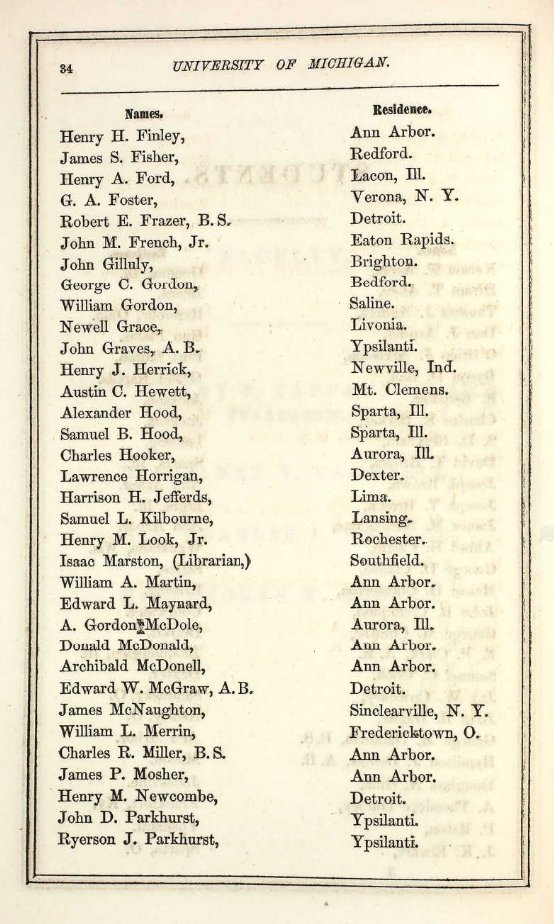
Samuel was hungry to learn. One early biographer, George Washington Smith, noted that, from a young age, Samuel was “distinguished by studious traits and had an ambition to secure a better education than could be obtained in the local schools.” By 1860, when he was 26, Samuel’s own education had progressed far enough that he was working as a teacher at Union Academy alongside his roommate, Isaac Brown. He also taught in the neighboring community of Eden, which had also been settled by forward-thinking Presbyterians. Soon enough, both Samuel and Isaac would join Samuel’s elder brother, Alexander, as students at the University of Michigan in Ann Arbor. There, Samuel and Alexander studied law, while Isaac enrolled as a medical student. Samuel’s passion for education extended beyond his own access to learning. He also strongly believed in the notion that making education widely available was a great benefit to society.
Soon enough, though, brewing changes for the nation put education on the backburner for Samuel. On April 12, 1861, the American Civil War began with the Battle of Fort Sumter in Samuel’s native South Carolina. Though he had spent much of his childhood in the South, Samuel’s allegiance lay firmly with the Union cause. On June 25, 1861, Samuel enlisted in the Union Army, joining the 22nd Illinois Infantry as a sergeant when the regiment was mustered in at Caseyville in St. Clair County. He was assigned to Company I, which consisted almost entirely of young men from Randolph County. Several close friends and family connections enlisted in the same company, including Isaac Brown, who became a military surgeon, and Rufus Tovrea, a saddler from Sparta whose brother was married to Samuel’s sister Rosa.
The 22nd Illinois was sent after its formation to Bird’s Point near Cairo, the site of a Confederate camp near the confluence of the Ohio and Mississippi Rivers. There, the regiment had its first experience with combat. In August 1861, the soldiers clashed with troops from the Missouri State Guard. In what became known as the Battle of Charleston, the Illinois soldiers managed to destroy the Confederate camp. The 22nd Illinois would remain at Bird’s Point for several months. There, less than a week after the battle, Samuel’s friend, Rufus Tovrea, passed away after contracting typhoid fever. More losses would come soon enough. Under the command of General Ulysses S. Grant, the regiment fought in the Battle of Belmont on November 7, 1861. The chaotic battlefield experience led to the losses of hundreds without a conclusive result.
For the next several months, Samuel and his fellow infantrymen took part in operations in Missouri and Tennessee, including the capture of Tiptonville on April 8, 1862. Shortly afterward, while taking part in the siege of Corinth, Mississippi, Samuel suddenly found himself in line for a promotion. On May 11, 1862, he was promoted to the rank of 2nd lieutenant following the resignation of Captain John Detrich of Sparta. Only a few weeks later, on June 28, Samuel was promoted to 1st lieutenant, taking the place of the company’s quartermaster, Hugh C. McCormack. The Sparta blacksmith had also decided to resign his commission and return home to his family.
Samuel’s new role as quartermaster was undertaken at the request of his fellow soldiers, who appointed him for the job. He reportedly accepted reluctantly, but once he took on the position, he flourished–and even uncovered illegal activity. Securing and distributing supplies, including clothing, weapons, and food, was an incredibly difficult task. Many necessary items were in short supply, and the situation was made worse by those who intercepted goods along the supply chain. Years later, the Sparta Plaindealer reported, “While acting Quartermaster, [Samuel] received from Quartermaster General Meigs a letter of thanks for discovering and exposing a system of frauds, in which certain army officers and rebel claimants were interested.”

The 22nd Illinois moved on to Alabama and Tennessee after the siege of Corinth, moving through Nashville toward Murfreesboro. There, in December 1862, they fought in the Battle of Stones River, one of the bloodiest conflicts of the war. Almost a third of the total number of men who participated were killed, wounded, captured, or went missing. The 22nd Illinois lost every horse they possessed in the battle, and Lt. Col. Francis Swanwick of Chester was captured by the Confederates and held prisoner for several months afterward. Several men from Company I were killed, including John Beck of Eden, John Mark and William Ross of Sparta, and Thomas Malone of rural Randolph County. Two more Sparta men, John Lafferty and Francis Lewis, were wounded in the battle and later discharged from the army. Though there was no decisive victor in the battle, the Confederates retreated, leaving Murfreesboro behind.
When they departed, however, the Confederates also took Samuel with them. According to his daughter, he was captured as a prisoner of war at Murfreesboro. It’s possible that he was transferred, along with Francis Swanwick, to Libby Prison in Richmond, Virginia, where Union officers were held after their capture. Samuel was certainly held for some weeks before the Confederates agreed to free him in a prisoner exchange. But, according to Sadie Hood, there were moments when Samuel thought he would suffer a more dire fate. She noted that a Confederate officer learned about Samuel’s South Carolina roots during his imprisonment and declared that Samuel should be shot as a traitor. Samuel apparently feared that he would indeed be killed up until the moment that he was freed.
Following the prisoner exchange, Samuel found himself at Camp Chase, a training camp and prison facility run by the Union in Columbus, Ohio. There, in February 1863, he wrote a letter home to his sister, Rosa. He noted that he was comfortably lodged at Four Mile House, the camp’s headquarters, but would soon be returning to his regiment in Tennessee. He described the overall conditions at the camp as damp and dismal, but he ended his letter with a positive wish: “In hope of a better happier day coming both for our country and ourselves.”
Samuel returned to the 22nd Illinois, which remained in Tennessee for several more months before heading toward Georgia. On September 19, 1863, the soldiers fought in the bloody Battle of Chickamauga. By then, the depleted 22nd Illinois consisted of around 300 officers and soldiers. The Union lost the battle and suffered heavy casualties. Samuel’s regiment didn’t escape the carnage. In less than ten minutes during the fighting, the regiment lost 96 men, including Captain Milton French of Sparta from Company I. He died of his wounds a week later. The company also lost Gabriel Brown of Steeleville and Benjamin Gibbons of rural Randolph County in the fighting. Another local soldier, James P. Brown of Sparta, was wounded and taken prisoner, dying a few days afterward. Thomas McDill of Sparta, one of the company’s fife players, was taken prisoner as well. During the battle, Samuel also suffered a head wound from a bullet that pierced his hat. In total, the 22nd Illinois lost 135 men during the battle.
The loss of Captain French meant that officers needed to be promoted within Company I to fill his place. Samuel, still recovering from his own wounds, was tapped as his replacement. He was promoted to captain on the day of French’s death. Samuel’s elevation came at a time when the regiment was suffering greatly. In the aftermath of the battle, they remained near Chattanooga in eastern Tennessee, desperately in need of shelter and basic provisions. And then, they were called upon again on November 25, 1863, to participate in the storming of nearby Missionary Ridge. The ranks of the regiment were reduced once again, with as many as 40 men lost. Samuel was seriously wounded in the battle, suffering injuries to his shoulder and one of his legs. His daughter later wrote that one of his fellow soldiers, Gideon Carson of Sparta, expended great effort to help care for Samuel in the days that followed.
After the battle, which resulted in a Union victory, the remaining men of the 22nd Illinois wearily marched to Knoxville, where they weathered the difficult winter that followed. In March 1864 they finally found some relief, receiving a full ration of provisions and accommodations in cabins at Loudon, Tennessee. It was a brief respite before their final contributions toward the Union cause. The regiment joined General Sherman’s army for the start of his Atlanta Campaign. Samuel and the men of the 22nd Illinois fought with Sherman from Rocky Face Ridge to Pickett’s Mill. And then, on the morning of June 10, 1864, the men of the regiment were ordered to return to Illinois. With the exception of a few veterans and recruits, who were transferred to a different regiment, the officers and soldiers were returned to Springfield to be mustered out of the army after a long three years of service.
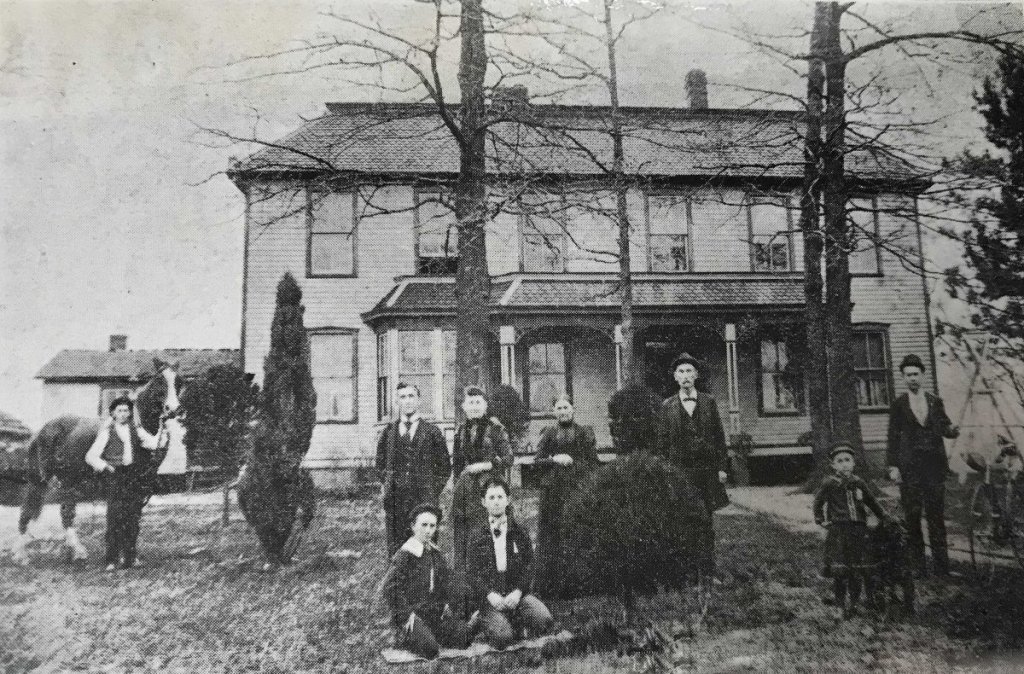
Samuel was 30 years old when he returned home to Sparta. He would remain close to his friends from the regiment for years, becoming an active member of the G.A.R. But his next chapter quickly dawned. On October 11, 1864, Samuel married Margaret Jane Frazier at her parents’ home near Sparta. Twenty-year-old Margaret was the daughter of a Presbyterian family who had moved to Illinois from West Virginia shortly before her birth. Samuel and Margaret settled on St. Louis Street in Sparta, where he resumed his old teaching job. The couple soon started a family of their own, welcoming a daughter, Sadie, and six sons, William, John, Samuel Jr., George, Robert, and Allen. (The youngest, Allen, received the middle name “Carson” in honor of the friend who had helped save Samuel’s life during the war.) Two more children died in infancy. Samuel and Margaret also welcomed other family members into their homes, especially Samuel’s younger sister, Bella, who lived with them while working as a teacher.
With a large and growing family to support, Samuel decided to try his hand at the mercantile business, turning to the provisioning skills he had honed as an army quartermaster. But soon enough, he found that he didn’t have the character required to turn a solid profit as a commercial merchant. George Washington Smith explains, “His kindly spirit and easy ways with those who owed him soon demonstrated that he was not well qualified for merchandising.” He was much more suited for the world of education, and he quickly returned to the classroom.
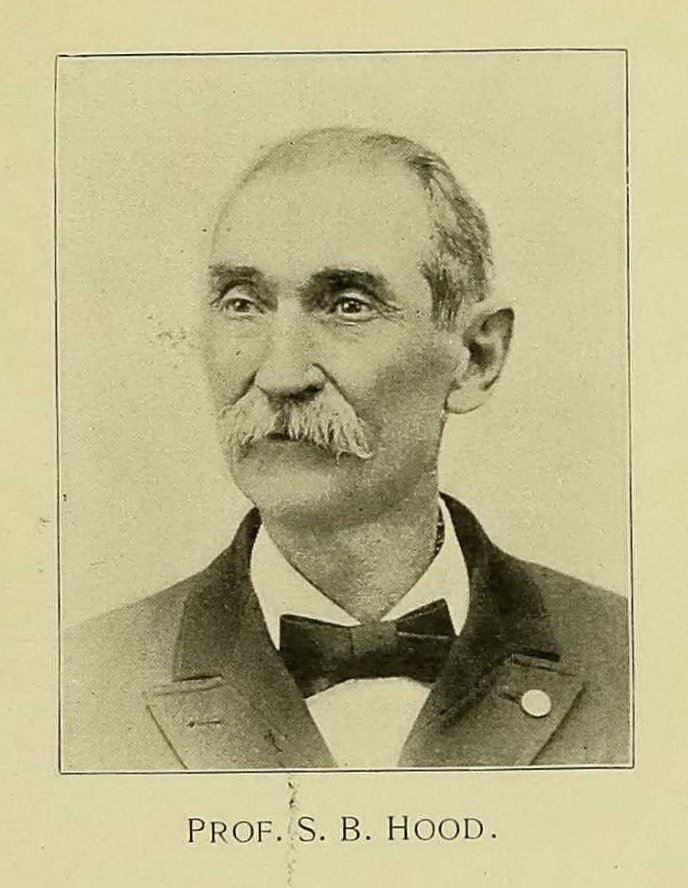
For the next forty years, schools were Samuel’s home. He became a celebrated and respected educator in Sparta, serving as both principal and superintendent in the district. In 1882, he was elected to serve as Randolph County’s Superintendent of Schools, a role he held for eight years. Samuel was especially recognized for his educational talents at Teachers’ Institutes across the area, including gatherings in Washington, Monroe, and St. Clair Counties. In 1894, Samuel threw his name in the ring for an even more influential role: the job of Illinois Superintendent of Schools. Newspapers like the Nashville Journal enthusiastically endorsed his candidacy, writing that “no man stands higher in the estimation of the people where he is known.” The paper added, “He is, and has been, principal of the public schools of Sparta, and those schools are on a par with the best in the State.” The endorsement concluded, “There are quite a number of able gentlemen seeking the position to which Prof. Hood aspires, but […] no better selection could be made than to place upon the ticket the name of Samuel B. Hood.”
Samuel was not elected to statewide office–George Washington Smith notes admiringly that he had “none of the gifts of a politician”–but he was part of other groups striving to make positive changes to the educational system in southern Illinois. Not long after he returned from the war, Samuel was a strong advocate for the first major university to be built in the area: “He was one of the originators of the movement in 1868 which secured for this part of the State the normal university at Carbondale.” That university, now Southern Illinois University Carbondale, was opened as a teacher training college in 1869. He reportedly was sought after by other educational institutions in other parts of the state, but he turned down all job offers to remain in Sparta.
Samuel was deeply interested in and dedicated to developing the strongest possible educational system for the students in his hometown. In the 1870s, he was part of the push for the establishment of a high school in Sparta. Just as with any educational change for a community, there was pushback, chiefly related to necessary taxation changes. In the 1903 high school yearbook, the student editors reflected, “Strange as it may seem now, twenty-five years ago quite a number of prominent Spartans were opposed to the High School, and the opposition was such that it required great prudence on the part of the Board of Education, and great perseverance and sacrifice on the part of the teachers to make it a success. But by the quiet, persistent and united efforts of its friends it gradually gained in public honor.”
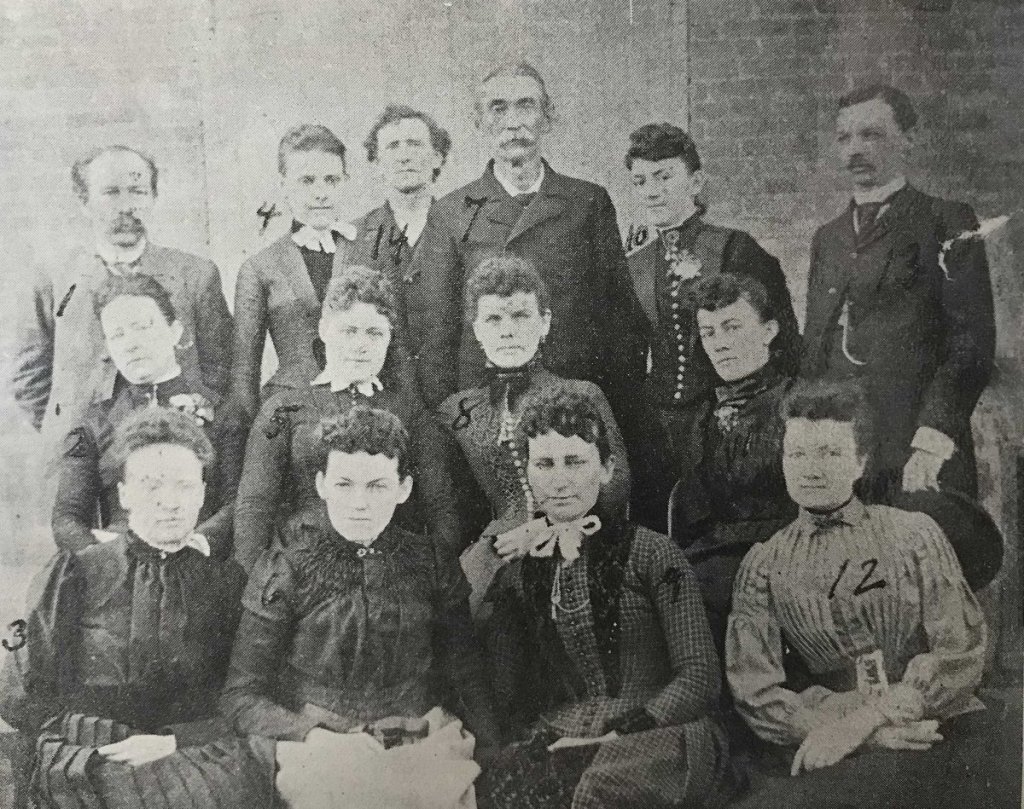
Samuel and his colleagues prevailed in establishing the high school, and soon children in Sparta were able to enroll in two- or four-year secondary education programs. An 1883 history of Randolph County describes the school building, located then at the corner of Main and St. Louis Streets in Sparta: “It is a fine brick building three stories in height and 63 by 83 feet on the ground. The play grounds are commodious and well adorned with shade trees. The school is divided into eight grades: four primary, three intermediate and a grammar and high school department. Fourteen teachers are employed, and there is a maximum of attendance of about 650 pupils.”
Students who wished to enroll at Sparta High School had a wide array of educational options available to them. One advertisement for prospective students, published in 1886, states that the school offered both classical and scientific courses of study, plus shorter specialty course options: “The courses embrace all the common branches, and zoology, botany, philosophy, physiology, geometry, algebra, elocution, rhetoric and composition, science of government, book-keeping, telegraphy and railroad book-keeping, chemistry, Latin, and Greek.” The Perry County Monitor and Sun reported the same year that Sparta’s high school “has been in a flourishing condition for several years, and has given a higher degree of intellectual training to a goodly number of young ladies and gentlemen that have attended, than the common schools can possibly give. It is worthy of patronage.” By 1904, the high school had also expanded its curriculum to include a much larger slate of business classes, including shorthand and commercial law courses.
Even while serving as superintendent, Samuel continued to teach classes in various subjects during the school year. Along with teaching and mentoring faculty members, Samuel also spent much of his time as a collector. George Washington Smith described Samuel as an “antiquarian” and “a collector of relics, particularly those with some historical value showing the stages of settlement and history in Illinois.” Much of his private collection was placed on display at a museum within the high school, allowing students and other interested parties to learn through the objects he collected. In the 1920s, the museum was moved to the grounds of Fort de Chartres near Prairie du Rocher with the permission of Samuel’s children.
By 1910, Samuel had retired from his formal teaching responsibilities. Now 75, he was able to live on his farm on the north end of St. Louis Street in Sparta, living off his own income with his wife and youngest son. In February 1914, at the age of 79, he passed away at his home in Sparta after a short illness. The Chester Tribune dubbed him “one of the town’s most prominent citizens,” and the Nashville Journal called him the “father of Sparta schools.” Samuel’s funeral was held on a Friday afternoon–a modest, somber affair, per his wishes–and the Tribune wrote that “nearly the entire population of Sparta” paid their respects during the visitation beforehand. As an extra mark of respect, the schools in Sparta closed on the day of the funeral, as did most of the town’s businesses. “In his death,” the Tribune concluded, “the people of Randolph County have lost a man who stood high in the rank of citizenship and influence.”
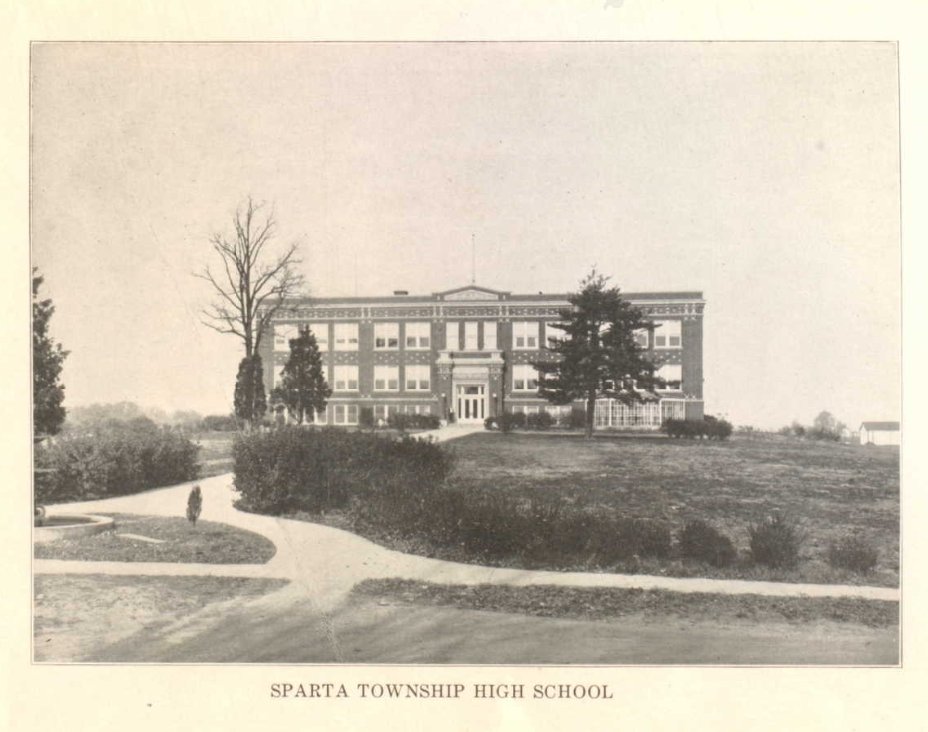
Indeed, Samuel’s influence in the educational community of Sparta continued even after his passing. When the town’s board of education decided to build a large new building for the high school in 1916, it was located on land that was once part of the Hood family farm. The street in front of the new school building was named “Hood Avenue” in Samuel’s honor. The high school’s large alumni community also raised money to commemorate Samuel’s contributions to the school in the form of a fountain, which was built in front of the new high school building and dedicated on May 15, 1919, which would have been Samuel’s 85th birthday.
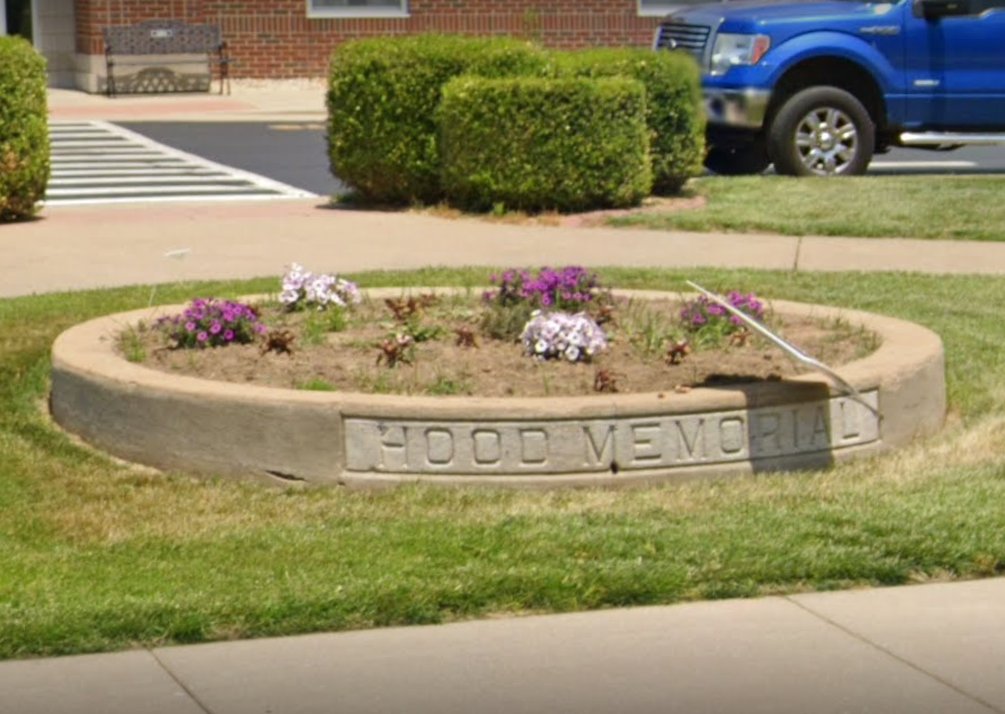
The Hood Memorial Fountain proved difficult to maintain, but the concrete base of the structure, filled with flowers, still exists outside of the high school today. In many ways, the endurance of the foundation of the memorial is an excellent metaphor for Samuel’s gifts to his community. Though the memory of Samuel’s specific contributions to Sparta’s educational system may have faded over the century since his death, his kind character and studious dedication to learning laid the foundation for the success of the generations that followed him–planting roots that still allow curious learners to blossom today.
Samuel Burns Hood was inducted into The Randolph Society in 2024.
 The Randolph Society