

An outstanding home-grown athlete who went on to an impressive professional football career, John Wittenborn devoted his life to teaching lessons about sportsmanship and character to the young athletes he mentored as a coach in Randolph County and beyond.
John Otis Wittenborn was born on March 1, 1936 in Sparta. The fifth of seven children of Raymond Wittenborn and Mabel Steffens Wittenborn, John grew up in a large farming family with deep roots in Randolph County. His great-grandfather, Carl Dietrich Wittenborn, emigrated from Germany to America in 1870, settling with his parents in Bremen and eventually starting a family that extended to include ten children and scores of grandchildren and great-grandchildren.
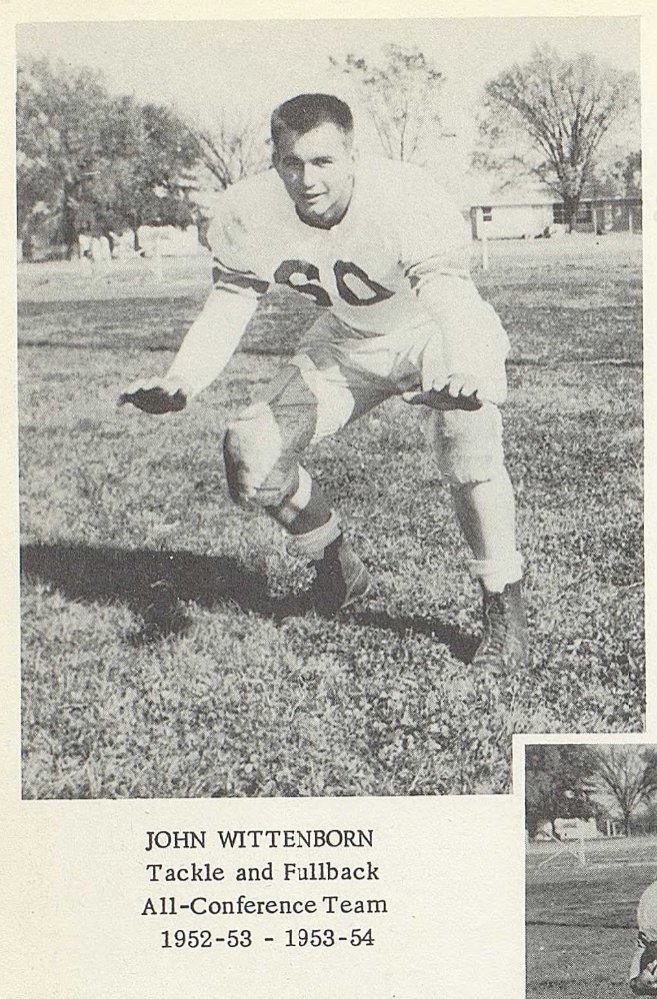
With his six brothers and sisters, John was raised on a dairy farm near Sparta and educated in Sparta schools. Like so many young men of his era, he initially expected to follow his father into the family farming business, joining the Future Farmers of America organization and entering in tractor pulling contests at the Randolph County Fair. But early on, John’s special athletic talent became evident. For all four years of his high school career, he was a three-sport athlete, playing football and basketball and running track. No surprise, then, that he was also voted “Most Athletic” in his senior year. (Well-liked by his peers, he was also named “Friendliest Boy” as a junior.) As a tackle and fullback on the football team, he was named to the All-Conference Team for the 1952-53 and 1953-54 seasons.
After his graduation in the spring of 1954, John was recruited to continue playing football at the collegiate level. The Southern Illinoisan wrote in May 1954 that John was “an all-around athlete” who was “considered a fine football prospect.” After an initial commitment to play at Southern Illinois University in Carbondale, John ultimately decided to continue both his education (majoring in agriculture and physical education) and his athletic career at Southeast Missouri State College in Cape Girardeau. Under Coach Kenneth Knox, the Cape State team earned a 7-2 record in John’s freshman year. By the start of his sophomore season in the autumn of 1955, the Sikeston Daily Standard already considered John to be one of the “outstanding veterans” on the team.
John’s second year on the SEMO team, however, proved to be a significant challenge. He was injured in the first game of the season, and just when he was prepared to make his return, he was hospitalized with polio. Thankfully, his case was a mild one, and he was able to rejoin the team. The season was an outstanding one, with the Cape team defeating all nine of their opponents and winning the conference championship. By John’s senior season in 1957, he was excelling as both a tackle and a kicker on the Cape team. A crucial part of another conference champion team, John earned personal accolades as well. He was elected as honorary co-captain of the 1957 football team, and he was also voted in as a first-team tackle on the all-conference team that November.

Just a few weeks after the end of the 1957 season, John’s football star blazed onto the national scene. On January 28, 1958, the NFL draft was held in Philadelphia. John was chosen by the San Francisco 49ers as the tenth pick in the 17th round of the draft. He was part of an outstanding draft class that included famous names like Alex Karras, Jim Taylor, and John Madden. The 49ers followed through and signed him in February 1958. The Mount Vernon Register-News noted, “John Wittenborn, high school grid star at Sparta a few years ago, has signed a $6,000 contract with the San Francisco 49ers.” By June, John had headed west to join the team in training camp. California newspapers reported that the rookie tackle quickly caught the eye of the team’s coaches: “Asked to pick the stand-outs among his muscle men, Line Coach Phil Bengston replied, ‘Wittenborn.’”
John didn’t just make the team as a rookie–he was selected as one of the starters for the first exhibition game of the season on August 30, 1958. Papers reported that head coach Frankie Albert chose John as the replacement for the injured veteran Lou Palatella. John shifted along the offensive line from tackle to guard, the position he would continue to play for several more years to come. But in the fall of 1958, a lengthy pro career didn’t feel at all like a certainty. With cuts on the horizon before the official season opener on September 28, John wasn’t guaranteed a spot. Pinckneyville native Warren Talley, then a sports editor for a newspaper in Menlo Park, California, assessed John’s chances for the Southern Illinoisan: “Wittenborn has looked very good in forming pass protection for John Brodie and Y.A. Tittle, but his main weakness is speed in pulling out of the line to block for a runner.”
Fortunately, John’s hard work and persistence paid off. Not only did he make the team, he was chosen as one of the starters for the home opener against the Pittsburgh Steelers at Kezar Stadium on September 26, 1958. Wearing number 66, the 6’1”, 230 lb. right guard was on the field for all twelve games in his rookie season. With a 6-6 record, the team finished in fourth place in the NFL Western Conference standings, behind the Baltimore Colts, the Los Angeles Rams, and the Chicago Bears, and missed the playoffs. 49ers Coach Frankie Albert was tough in his assessment of the offensive line during the disappointing season, though he often singled John out for individual praise. In October 1958, the St. Louis Globe-Democrat featured one of those comments in a write-up of the 49ers loss to the Bears: “One of the rookies, John Wittenborn, an offensive guard, came in for praise from the furious coach. Wittenborn played an aggressive game, and was penalized 15 yards for clipping to stall a drive. ‘Maybe we need more guys who will clip once in a while,’ said Albert.”
John’s dedicated play earned him a solid place on the San Francisco team, and when he reported to training camp in the summer of 1959, he was one of fourteen veteran players on the squad. There were high hopes that the team could improve on the previous year’s performance. Frankie Albert had resigned after the 1958 season, and assistant coach Red Hickey had been promoted to the top job. John only started one game during the 1959 season, but once again he played in all of the team’s twelve contests. Now a veteran of the precarious job security in the NFL, John also sought to become a more versatile player option for the club. Just as he had in college, he continued to hone his skills as a kicker, even auditioning to replace the club’s retired kicker during the season.
The 49ers chalked up another disappointing season in 1959, ending with a 7-5 record despite a promising 6-1 start. They missed the playoffs for a second consecutive season, finishing third in the conference standings. In 1960, John began his third NFL season as the backup right guard for the 49ers behind Ted Connolly. He played in the first four games of the season–wins over the Los Angeles Rams and the Detroit Lions, and losses to the New York Giants and the Chicago Bears–but the organization struggled to find a consistent place for him on the field. During the game against the Lions at Tiger Stadium on October 9, John was assigned to take over as the team’s kicker. Unfortunately, he wasn’t able to make any of the three field goals he attempted.

On October 17, a stroke of luck would lead John to one of the highest moments of his playing career. The 49ers decided to trade him to the Philadelphia Eagles in exchange for defensive end Jerry Wilson. John packed up to travel across the country, joining the Eagles in Cleveland in time for their game against the Browns on October 23. With a new number, 62, John added needed strength to Philadelphia’s offensive line. Coach Buck Shaw quickly found a place for John as a right guard, replacing the injured Stan Campbell.
The Philadelphia Daily News ran a profile on John just a few weeks after his arrival in Pennsylvania. “Most of the 58,234 fans at Franklin Field had to check their programs yesterday to identify that chunky number 62 on the Eagles line. He’s John Otis Wittenborn, the speedy 225-pound handyman the Eagles picked up three weeks ago,” the paper noted. Jack McKinney interviewed Shaw, who declared that “Wittenborn has been one of the most pleasant surprises of the season.” John was equally pleased to be with the team. “I feel lucky to be here,” he said. “I’ll play anywhere they can use me. The Eagles are a great bunch of guys and it’s a real pleasure to play under a gentleman like Buck Shaw.”
John couldn’t have known just how wonderful his 1960 season with the Philadelphia Eagles would turn out to be. He had joined the team in the middle of an incredible winning streak, and the Eagles would only drop one contest, against the Pittsburgh Steelers in November, during John’s first season with the team. By December, John found himself playing with the Eagles close to home, in a game against the St. Louis Cardinals at Sportsman’s Park, the city’s dual baseball/football stadium, which had recently been named Busch Stadium in honor of its new owners. The Eagles won first place in the NFL Eastern Conference, with even utility players like John becoming local celebrities in Philadelphia. Newspapers advertised chances for fans to meet the players, including John, in person as they celebrated their conference victory.
On December 26, the Eagles hosted Vince Lombardi’s Green Bay Packers at Franklin Field on the campus of the University of Pennsylvania for the league championship game. Because the game was televised by NBC, and the field didn’t have lights, the contest was scheduled for noon–and because Christmas Day had fallen on a Sunday that year, the game was held on a Monday. Regardless, more than 67,000 fans packed the stadium to see the championship game, which many consider to be an important moment in the development of the sport. Green Bay, in just their second season with Lombardi at the helm, was led by quarterback Bart Starr and halfback/kicker Paul Hornung. The Eagles’ quarterback, Norm Van Brocklin, was playing in what would be his final game. He was hired as the head coach of the league’s new expansion team, the Minnesota Vikings, only a few weeks after the season ended.
John was playing in the first (and only) championship contest of his professional career, and even though he wasn’t starting the game, he ended up getting some interesting press thanks to an old friendship. A week before the game, newspapers reported, “When the Green Bay Packers play the Philadelphia Eagles next Monday for the National Football League championship, little Southeast Missouri State College is bound to be on the side of the winner. John Wittenborn, an offensive lineman with the Eagles, and Ken Iman, a rookie center with the Packers, are graduates of the school at Cape Girardeau, Mo. The two were close friends in college and Monday Iman received a telegram from Wittenborn saying, ‘Congratulations. See you in Philadelphia. Witt.’”
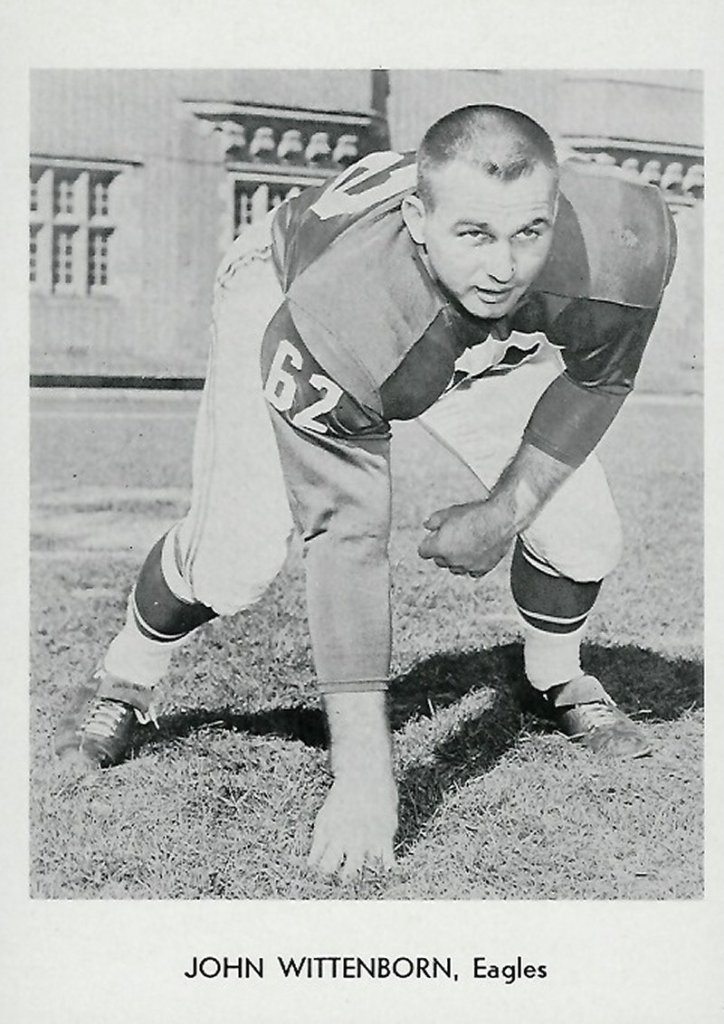
Witt and his teammates prevailed. The Eagles scored a pair of touchdowns and a field goal, defeating the Packers 17-13. It would be the only time that Vince Lombardi lost a playoff game in his professional coaching career. The game brought in almost $750,000 in revenue, and John and his teammates each received a player’s share of $5,116 (something in the neighborhood of $130,000 today). John must have felt like he was on top of the world. The early 1960s brought him to the heights of his professional success, and his home life was full of joy as well. He made his home in Cape Girardeau during the off season, settling down with a fellow SEMO student, Janet Lou Graham, and welcoming a daughter, Julie, and two sons, Jeff and Jay.
But there was also a reminder during that landmark 1960 season of the dangers of the game that John played. On November 20, 1960, the Eagles played the New York Giants at Yankee Stadium in the Bronx. In the game’s fourth quarter, John watched from the sideline as the Giants’ running back Frank Gifford was tackled by Eagles linebacker Chuck Bednarik. Gifford was knocked unconscious and had to be carried off the field on a stretcher. The moment has become known simply as “The Hit.” Gifford was diagnosed with a severe concussion and spent more than a week in the hospital. It would be eighteen months before he would play professional football again. Ironically, John came into the game on November 20 off the bench as a replacement for starter Gerry Huth, who had also suffered a concussion. In his report on the game, Jack McKinney of the Philadelphia Daily News revealed that Huth “hadn’t been functioning well mentally at left guard due to a first-half head injury.” Both Gifford and Huth were diagnosed after their deaths with CTE, a degenerative brain disorder caused by repetitive head injuries. It would be decades before the NFL would even begin to reckon with the damage caused to players by repeated concussions.
John remained on the Eagles roster for the next two seasons. He started in every game for the Eagles in 1961, but the team narrowly missed a return to the championship game, playing for third place (and losing to the Detroit Lions) in the Playoff Bowl instead. Hopes were high for the 1962 season–but they were soon dashed. The team ended up with a dismal 3-10-1 record, finishing in last place in the conference standings. John began the season as a starter but was shifted in and out of the role as the coaches attempted to kickstart the flagging offense. And then, John found himself on the injured list after suffering a broken finger. Thankfully, though, his feet were perfectly fine, because he was quickly called upon to sub in for injured kicker Bobby Walston on field goal attempts. The Philadelphia Inquirer reported that John had kicking experience dating back to his time at SEMO and was “considered to have one of the strongest legs on the team.” John kicked a 27-yard field goal in a victory over Washington on December 2, and a week later, he made an 18-yard attempt in the team’s loss to the Pittsburgh Steelers at home.
In 1963, John suddenly had a chance to play football closer to home. The St. Louis Post-Dispatch reported on June 26 that the “football Cardinals acquired offensive guard John Wittenborn from the Philadelphia Eagles today,” noting that the Cardinals hoped that John “would help fill a hole at guard left vacant by Mike McGee, who retired on advice of a doctor after a neck injury.” The Globe-Democrat wrote that many of John’s former college teammates remained in the area and anticipated that he would “bring groups of his friends to games” in St. Louis. He even hoped to move his wife and young children to St. Louis if he was able to find success with the team. But then, during training camp, John suffered a sprained shoulder during a scrimmage. He spent the rest of the 1963 season on the club’s taxi squad, and in August 1964, the Cardinals made the decision to cut him from the team.
Twenty-eight-year-old John was at a crossroads. He granted an interview to the Southern Illinoisan to discuss his options for the future. “Wittenborn is caught in the era of uncertainty which faces so many professional athletes when they come to the point of decision on whether to try to continue in sports or seek a new future,” the article noted. The head football coaching job was open at Sparta High School, a tantalizing prospect. Instead, though, pro football came calling again. Just days before the first game of the season, John was picked up by the Houston Oilers, a team that was then part of the NFL’s rival American Football League. Wearing number 67, he started at right guard in nine games for the Oilers in 1964. Unfortunately, the season was a disappointment, with the franchise finishing in last place in the AFL’s Eastern Division.
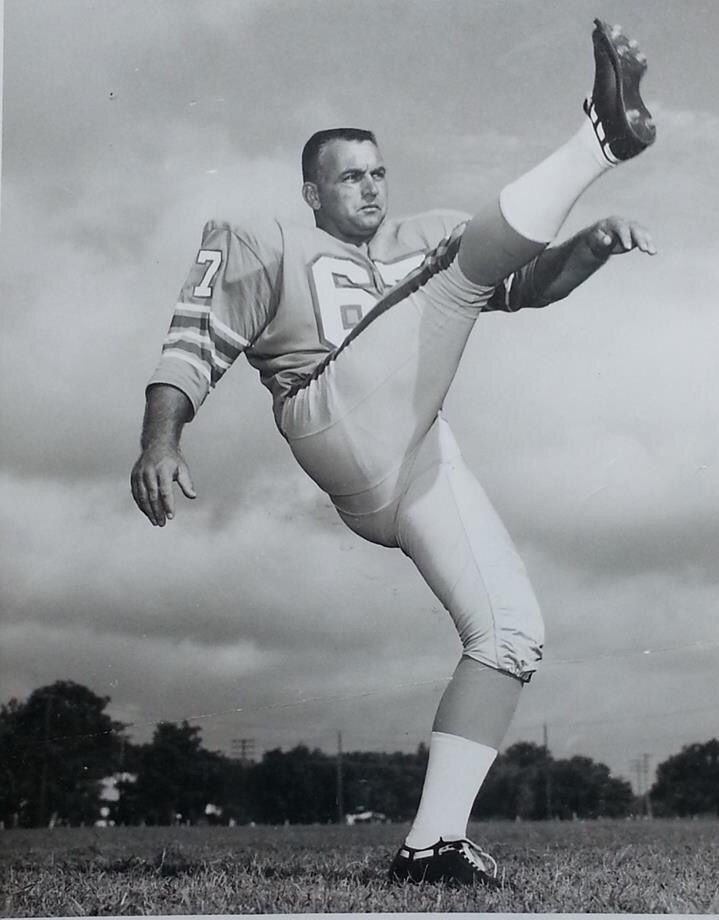
John also suffered disappointment near the end of the 1964 season, injuring his knee in a game against the Boston Patriots in late November. However, he was able to return for Houston the following year, though he started in just one game. The Oilers notched another 4-10 record that year, and in 1966, when John came off the bench as a reserve guard once again, they were even worse at 3-11. In the 1967 season, though, John got a chance to show off one of his other football skills once again. Now the most veteran player on the Oilers team, 30-year-old John won the role of kicker, responsible for kickoffs, field goals, and extra point attempts. He kicked in 14 games for the Oilers in 1967, making 100% of his extra point attempts and 50% of his field goals, with a 47-yard kick as his longest successful attempt. The Oilers had a renaissance that season, winning the AFL Eastern Division but losing the AFL championship game to the Oakland Raiders.
John returned as a member of Houston’s roster in 1968, kicking for the team in six games. By October, though, an injury had sidelined him once more. The Oilers placed him on injured waivers after the team’s win over the Boston Patriots at Fenway Park. In January 1969, 32-year-old John officially announced his retirement from professional football. His career had spanned eleven years with three teams in two leagues, including that golden championship season in Philadelphia. He told the Southern Illinoisan, “I suffered a groin injury in our last exhibition game last fall. By the sixth game of the season it got so bad I could hardly trot off the field one game. That’s when I knew I was headed to retirement.” He also previewed his next career move. “I would like to get into some kind of business, but if a good high school coaching job opens, I would be interested.”
By June, a local high school jumped at the chance to have a former professional player serving as their football coach. The Southern reported that Murphysboro’s school board “hired John Wittenborn, a Sparta native, as head football coach and assistant in basketball, for the start of the new school year in September.” John was excited to shape the program, bringing his pro football experience to the young men of Murphysboro. “We’re going to be a pro type team. We’ll use everything. We’ll run inside and wide, and we’ll pass in all directions,” he told Tony Stevens of the Southern. He also had big plans to upgrade the equipment available to student-athletes, including a new whirlpool. The press affectionately dubbed him “Big John,” but the kids preferred to call him “Coach Witt.” The players responded enthusiastically to their new coach’s pro-inspired style. The team had a winning 6-3 record, and John told reporters that the public embraced the team heartily as well, with gate receipts “up $3,200 over the previous year.”

John’s success as a coach was confirmed when, in August 1970, more than 150 boys showed up for the physicals needed to be eligible to play on the team that fall. “In a school of 800 students, that was an amazing turnout. In fact, we don’t even have enough uniforms at the moment,” he told the press. Indeed, new uniforms were already being ordered, with an emphasis on continuing to model the team after the professionals that they loved to watch on television. “The team will wear completely new red-and-white uniforms, patterned after the Kansas City Chiefs of the American Football League,” Tony Stevens reported in the Southern Illinoisan. “Wittenborn said the uniforms will still retain the school colors, with a touch of gold on the helmet and stockings.” John also teased another morale-boosting addition inspired by college teams: helmet decals to recognize players’ individual achievements. The team improved to 8-2 under John’s leadership during his second season heading the program.
Along with rebuilding the football program and assisting with the basketball team, John also coached the track team. For students wanting to try new activities and sports, he was also part of introducing weight-lifting and archery to the campus. But a pair of difficult incidents also tested John’s leadership skills and his coolness under pressure during his first years at Murphysboro. In February 1970, he was injured by a student after confronting the young man during an attempted theft in the locker rooms at the school gym. And that September, he was one of the first people on the scene when a teenager was struck by lightning outside the high school. With the help of an assistant principal and a student, he was able to revive the young man, who survived.
John’s coaching success at Murphysboro, paired with his lengthy playing career and his many connections in the world of professional football, set him up for his next career move. John was a charter member of the NFL Players Association, and he maintained close friendship with several players and coaches from his professional days. In January 1973, the University of Tulsa announced that John had been hired as the school’s new offensive line coach. He joined the staff of head coach F.A. Dry, who had been the offensive line coach of the Houston Oilers during John’s time with the team in the late 1960s. John told the Southern Illinoisan, “It is an opportunity I have always wanted–strictly coaching with no teaching. I will also be able to work on my master’s degree–not as a step to getting back to the teaching field–but because I would probably need a master’s if I ever get a chance for a head job at the college level.” Initially, John planned for his wife and children to join him in Oklahoma, but his marriage ultimately foundered, and he would go on to marry twice more.
The rigorous schedule of NCAA football couldn’t have helped where family stability was concerned. The job was a demanding one, including the continual pressures of recruiting new prospects from across the country. In his early seasons at Tulsa, he found himself working with an inexperienced roster of players who needed increased attention and mentorship. Ultimately, the coaching staff at Tulsa was able to assemble an impressive record during John’s tenure there, winning the Missouri Valley Conference championship in four straight seasons. Other universities took notice. Texas Christian University hired F.A. Dry to become their new head football coach in 1976.
John was one of the candidates interviewed to take over as Tulsa’s new head coach, but the job went to John Cooper, an assistant coach from Kentucky. Ultimately, John decided to stay on as one of Cooper’s assistants. “John Wittenborn is a fine coach, and I am extremely pleased that he has decided to remain at Tulsa,” Cooper told the Tulsa World. The players at Tulsa were happy to have John staying on the staff as well. “Coach Wittenborn is a great coach in instilling the kind of pride it takes to be an offensive lineman,” offensive guard Mike Gladson told one reporter. “You play for self-pride and for your school and to help your team win. That’s usually all there is for an offensive lineman, and to us, that’s a lot.” A teammate, Denver Johnson, echoed the same sentiments: “I like Coach Witt. He’s a good coach and he shoots straight with you.”

Though John earned accolades from his players and fellow staff members, he found himself continuing to look for new challenges. In June 1980, at the age of 44, he resigned from his position at the university to take on the job of head football coach and athletic director at Mannford High School in a small rural community not far from Tulsa. John was ready for a change of scenery. “I guess you’d have to say there’s a lot of country in me,” he told the Tulsa World. “I don’t regard it as a step down, although a lot of coaches would call it that. When I retired from playing pro football, I was a high school coach for four years in my home area of southern Illinois, and I enjoyed the heck out of it. I’m looking forward to getting back in high school coaching in a rural setting.” The change of pace, he explained, would be a welcome one. “I peeked out of that film room from time to time and realized the world was going by. I wasn’t unhappy at TU, but it just isn’t my lifestyle. I’m not a big city boy. I couldn’t see myself at age 50 still beating the bushes and begging kids to come to TU.”
Just as he had done at Murphysboro, John used stories and experiences from his pro football days to motivate the young players on his team at Mannford. Twenty years after winning the championship with Philadelphia, he especially liked to share stories from his Eagles days. “We were terrible [at Mannford] this year, with only one way to go. We were young, weak, and slow. I got ’em in the weight room now, explaining what it takes, telling them about what it took to win in ’60,” he told the Philadelphia Daily News in 1981. The team struggled to gain ground in his first seasons at Mannford, but he slowly developed a solid football program at the school.
Despite a direct hit from a tornado that damaged their facilities in the spring of 1984, the Mannford team was especially impressive that autumn. John was named an All-Metro Coach of the Year by the Tulsa World in recognition of their tenacity and surprise success. “The thing that made it most gratifying,” John told the paper, “is that the kids really took to coaching. We hadn’t had many good seasons out here and they were hungry to win.” John continued to lead the Mannford team to success over the next several years, coaching until he decided to hand in his resignation in December 1990. He finished his coaching career at the school with a 72-47 record.
John and his wife, Sharron, ultimately decided to make the move from Oklahoma back to his native Illinois. They settled down in Cutler, where he could live the quiet rural life he preferred, focusing on his favorite hobbies, especially coon hunting. But the coaching bug soon bit him once more. In 1999, he was hired as one of the coaches of the Elverado-Trico coop football team. He was responsible for supervising and mentoring the players at Trico, where he also worked as a special education aide and pitched in as a substitute bus driver. Fellow coach Rich Williams singled John out for praise in an interview at the start of the season. “John has been tremendous,” he told the Southern. “I’ve never been around a man who knows more about football. He’s forgotten more about football than most people know. Having a man with that experience is a big feather in our hat.”
Two years later, John’s football career finally came full circle. Now 65, he was hired as the head football coach at Sparta High School, returning to the place where he had first learned the game a half century earlier. “He’s been wanted in the community for a long, long time,” Sparta’s athletic director, David Peck, revealed. For John, Sparta had always been particularly special. “I wouldn’t have considered doing this any other place,” he said. “The sport of football has been very good to me and has given me a great deal,” he told the Belleville News-Democrat in August 2001. “I just felt like I’m still in good health and so I wanted to give back. A lot of these kids, especially the seniors, don’t know how to win. To me it’s just confidence, knowing what you are doing and having the confidence to do it.”

After one final season with his beloved Bulldogs, John stepped down as head coach of the program. In his retirement years, he was able to look on proudly as his lengthy career was recognized by many of the organizations that had shaped him as an athlete and a man. He was regularly included in roundups focused on the 1960 championship Philadelphia Eagles, and in October 2003, he was inducted as a member of Southeast Missouri State University’s Athletic Hall of Fame. In September 2011, Sparta High School retired John’s jersey.
John passed away in Carbondale on March 29, 2016, at the age of 80. He was survived by his wife, Sharron, and his children and stepchildren, as well as numerous beloved grandchildren. He was also deeply mourned and fondly remembered by the numerous athletes he played with, coached with, and mentored over the course of his remarkable football career. Steve Cox, a Tulsa alum who became a kicker for the Cleveland Browns, once remembered that John “was the greatest kicking coach [he] ever had.” But, even for football players like Cox, John was more than a championship athlete or a successful coach. “He’s simply a great guy, any way you look at it.”
John Wittenborn was inducted into the Randolph Society in 2024.
 The Randolph Society