
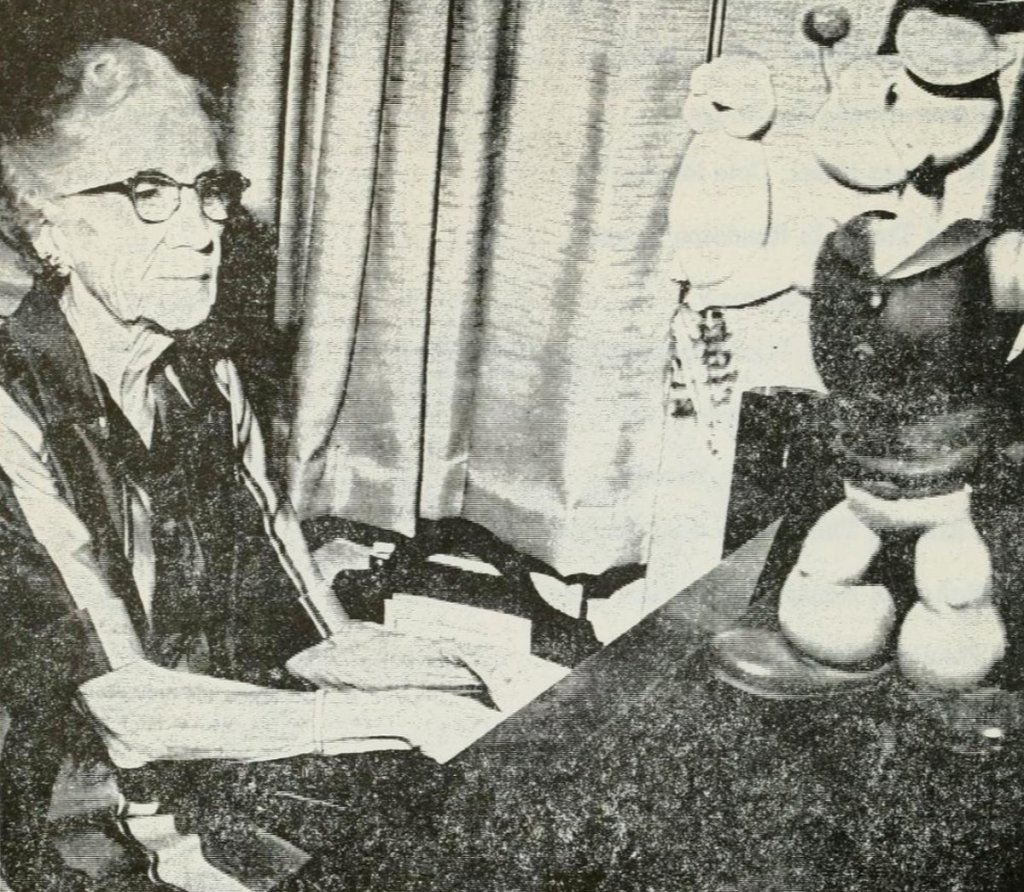
A musician, educator, and historian, Jessie Lee Huffstutler spent years sharing her musical gifts with the people of Randolph County, including students, parishioners, and even inmates at the local prison.
Jessie Lee Gant was born in Chester on February 2, 1888. She was the fourth child and only daughter of Darius Gant and Rachell Maxwell Gant, joining brothers Elmer, Otto, and Ora. Her father’s family had moved from Kentucky to Diamond Cross in rural Randolph County in the 1820s, while her mother’s parents had emigrated from Scotland.
Jessie was only five years old when her father unexpectedly passed away, leaving behind a widow and four children. The young family moved in with Rachel Gant’s sister, Ellen Walsh, who was a talented seamstress working in Chester. The entire family had a talent for precision. Rachel pitched in to help her sister as a dressmaker, while Elmer became a civil engineering contractor, Otto operated a dredging boat, and Ora was employed as a railroad surveyor.
Young Jessie discovered that her talents lay in the world of music. Her proficiency as a pianist was evident from childhood, and she began playing and singing in the choir at Chester’s First Methodist Church when she was just twelve. She was so skilled that she was also hired by Bill Schuchert to play piano accompaniment for silent films at the Chester Opera House. The job required some creativity. Film reels did not come with pre-planned musical selections, so Jessie had to decide which pieces best fit the mood of each picture.

She turned often to a song book from her own collection to select the music. “For the silent movies my choice of music varied,” she recalled later. “I used popular, rag-time and semi-classics. On Saturday evenings we always had The Perils of Pauline and sometimes I used Waves of the Ocean. It seemed to fit Pauline’s many mishaps which kept us on the edges of our chairs.” Keeping time on the drums beside her was one of her childhood friends, Elzie Segar, who would later include memories from their teenage days at the movie theater in his famous Popeye cartoons.
Jessie’s musical talents were also displayed in live productions and concerts at the Opera House. The Chester Tribune recorded in the autumn of 1897 that “little Miss Jessie Lee Gant sang a beautiful song in a becoming manner” during an amateur night contest held at the theater. She was encouraged to develop her talent by her entire family, and a Tribune column in June 1903 revealed that she was “rejoicing over a new Kimball piano, a present from her brothers Elmer, Ora and Otto.”
When Jessie graduated from Chester High School in the spring of 1905, her musical prowess was showcased alongside that of her classmates during their commencement ceremony. Because so many of the graduates were capable musicians, the class had formed their own orchestra, and they played selections during the graduation ceremony. Jessie, showing her mastery of multiple instruments, played the violin as part of the ensemble. She also delivered a speech devoted to the subject of music. “Miss Gant has been a favorite socially among her young friends in the school, and older persons who have known of her abilities and promises in an intellectual way were not surprised at the excellence of her performance,” the Tribune’s reporter noted. “The subject is one difficult to handle, requiring the weaving into a poetic fabric the higher and finer threads of thought. Miss Gant did the subject justice, and her delivery was graceful and pleasing to her auditors.”
After graduation, Jessie continued to be a central part of young society in Chester. She was active in the Methodist Church’s youth organization, the Epworth League, and in the local Wednesday Literary Club. She taught Sunday School classes, starting off the first hints of an educational career to come. And shortly after finishing school, she was hired for an important local role, becoming the organist at Southern Illinois Penitentiary. Later in life, Jessie reminisced on the nerves she felt when arriving to play at the prison for the first time. “With much concern I met my choir of prisoners before service and with the Chaplain, chose the hymns to be used in the service,” she wrote. “This service was non-denominational. Soon the guards, whose seats were on elevations along the sides of the Chapel, took their places, the band began to play and doors opened from both sides. As the men filed in I had mixed emotions, seeing some so young and others so old. When the Chaplain arose to begin the service, I had myself under control and when time came for special music, I sang ‘The Holy City’ and from the applause I received, I knew they were now my friends and from that time, I was ‘Miss Jessie’ to them.”

Jessie’s work at the prison included numerous musical responsibilities, including playing the piano for an orchestra composed of inmates. “We played for many occasions including the first movies shown there on Saturday afternoons,” she recalled, “and also for the school graduation exercises for men who had completed the eighth grade, with special recognition given to those who had completed the third grade and now were able to read and write.” She also sang in a mixed quartet with the warden’s wife, Mrs. Smith, and two inmates, one who worked as the prison florist and the other who served as the facility’s librarian.
Jessie continued as part of the musical staff at the prison until 1929, and her memories from those decades encompassed a wide range of different experiences. One of the most poignant took place on Christmas Eve in 1927, when she arrived at the prison with fellow members of the Methodist choir. “At exactly midnight,” she remembered, “we entered the cell block, singing as we proceeded. Some dissenting voices could be heard at first. Then someone discovered that I was in the group and my name was quickly passed down the line and all became quiet as they listened with respect and later thanked us. We went into the yards that night also, over to the hospital and sang for the sick. This was a memorial night for all of us and not soon to be forgotten.”
A strong sense of the importance of community, reinforced by her time working at Menard, led Jessie to form long-lasting friendships. When close friends were married in the local churches, Jessie often played Mendelssohn’s Wedding March for the nuptials. In 1911, Jessie became a bride herself, marrying Fred “Dick” Huffstutler, a farmer from McLeansboro. Their only child, a son named Fred Elmer Huffstutler, was born later the same year. The little family settled down in a house on the corner of Hancock and Buena Vista Streets in Chester, where Dick briefly ran a local saloon before taking on a new job as a signal master with the railroad. Meanwhile, Jessie continued to serve as the organist at Menard, a role she would hold for more than two decades.
Sadly, the following years brought significant tragedy to Jessie’s life. In 1914, her mother, Rachel, died after a short illness, and her brother Otto passed the following year. The family waited impatiently for news from the front when another brother, Ora, joined the army’s engineering corps during World War I and was deployed to France. He survived the conflict, but sadly he too passed away before his time, dying of pneumonia in 1923.
The following months brought the greatest loss of all. On New Year’s Eve in 1923, Jessie’s husband was admitted to the Missouri Pacific Hospital in St. Louis after dealing with abdominal pain for more than a week. Doctors operated and eventually discovered that Fred was suffering from appendicitis. Complicating matters, however, was an even more consequential diagnosis: typhoid fever. On January 13, 1924, Dick passed away at the age of 35. Jessie, now a widow in her 30s, was left behind to raise their 12-year-old son, Fred Jr., alone. She continued to work as the prison’s organist to support her son, and she also gave private voice and piano lessons to earn extra money.
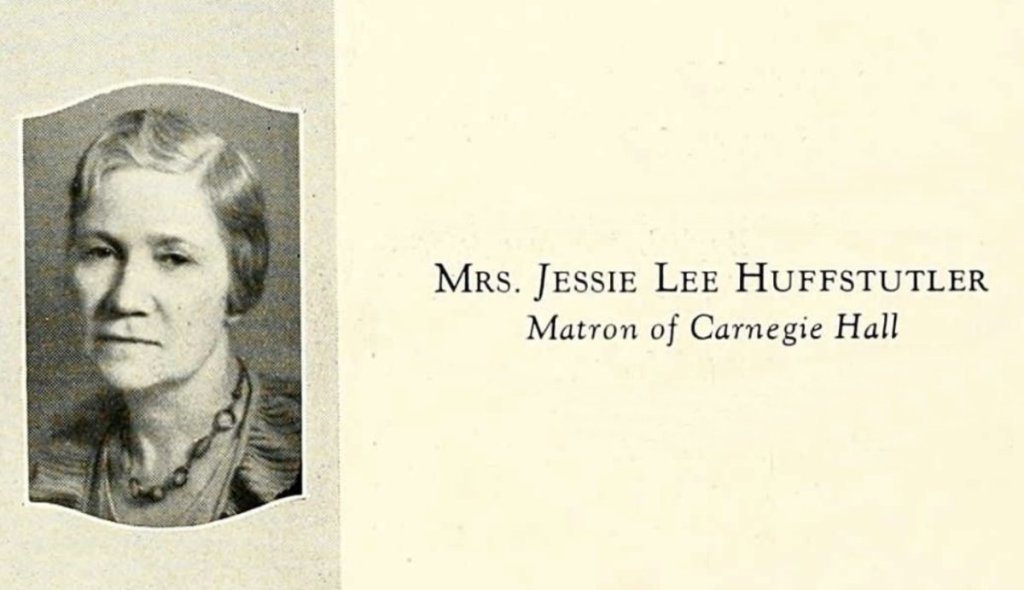
Jessie and young Fred stayed in Chester until he graduated from high school in 1929. Then, as he prepared to go off to college, Jessie decided to offer her resignation at Menard and take the chance to further her own education as well. Both mother and son headed to Lebanon and the campus of McKendree College. There, Fred enrolled in mathematics courses, while Jessie was hired as a house mother for one of the men’s dormitories and the accompanist for the men’s glee club. Meanwhile, she began taking classes, too. When Fred graduated in 1933 with his bachelor’s degree, Jessie also received a certificate in music education.
The newly-graduated Huffstutlers headed south. By 1935, they had settled on the east coast of Florida, where Jessie’s older brother, Elmer, was working as a road contractor in Melbourne. Jessie embarked on a new career as a public school teacher, while Fred married and started a family of his own. In the 1940s, Jessie watched proudly as her son served in the navy during World War II, and she rejoiced at the birth of a grandson and a granddaughter.
By the 1940s, Jessie decided to move back to Illinois. Both Elmer and Fred had pursued jobs in the coal industry in Kentucky, and Jessie had followed her love for education to Carbondale, where she completed additional course work at Southern Illinois Normal University. After teaching for several years in Dowell, she established herself in Du Quoin, where she joined the staff at the John B. Ward School. She also represented her fellow teachers at the state level, attending Illinois Education Association conferences, and locally, delivering remarks to the Du Quoin Business and Professional Women’s Club.
Jessie often traveled to Kentucky for visits with her brother and her son. Sadly, though, she had to mourn both of them, too. Elmer passed away in 1955, and Fred died three years later after a cancer diagnosis. By this time, Jessie had returned to the familiar territory of her childhood. After retiring from teaching in 1953, she settled once again in Chester, situating herself in the comforting community of the First Methodist Church. There, she once more became a central part of the music of the congregation, directing choral performances, serving as a hostess for dinners, and playing the piano and organ.
In May 1960, Jessie’s immense contributions to music at First Methodist Church and in Chester were recognized with a special celebration. The Southern Illinoisan reported that “Mrs. Jessie Lee Huffstutler of Chester was honored at a special program and reception in recognition of her 60 years of service in choir work.” A program full of music was followed by an informal reception in the church’s fellowship space. “During the services a letter recognizing her services at the prison was read by Warden Ross Randolph. A gift from the official board of the church was presented to her by Lawrence Lipe, chairman,” the reporter for the Southern explained.
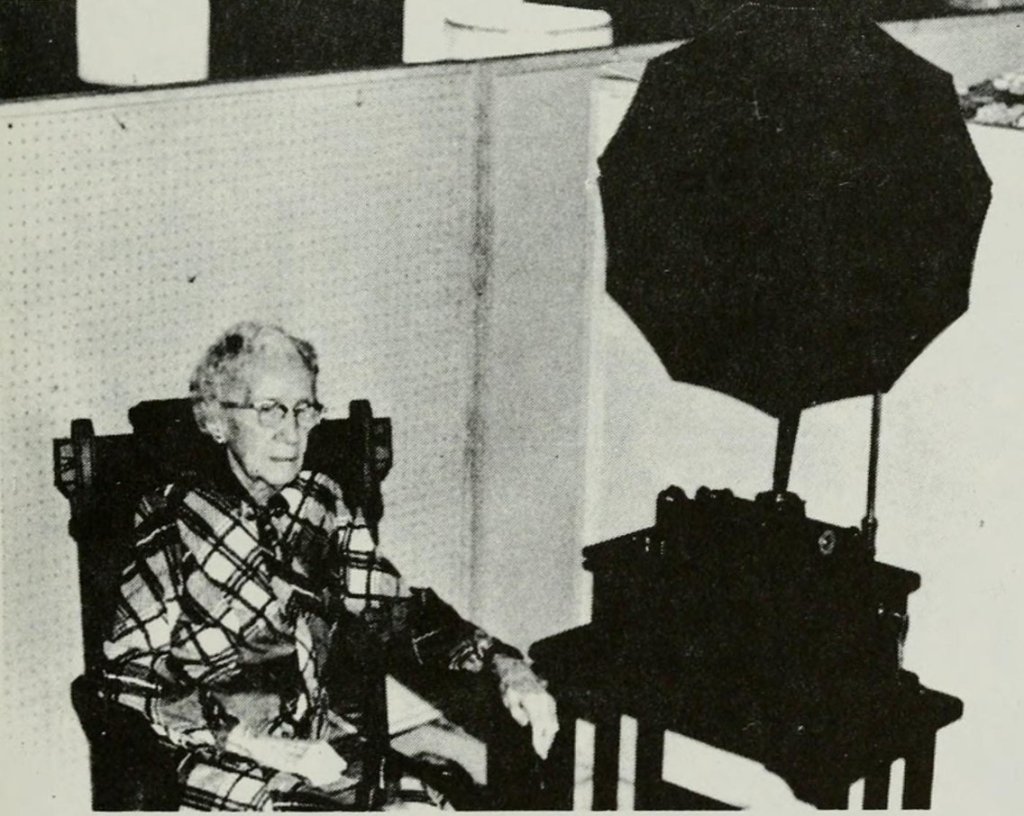
Another important community honor followed just a few days later. The Southern noted that “Mrs. Jessie Lee Huffstutler of Chester was named Honored Musician of the year at the May meeting of the Music Patrons of the Chester Community School. The meeting was held Wednesday at the Grade School, with about 500 members and guests attending the pot luck supper and musical program.” Jessie received a special pin during the ceremony to recognize her enduring service.
In her retirement years, Jessie also renewed her active membership in the Chester Women’s Club, hosting parties, giving talks on interesting topics, and organizing children’s story times at the local library. When the club formed a singing group called the “Kaskaskia Belles,” Jessie served as their accompanist. As a member of the Alpha Kappa chapter of the educational sorority Delta Kappa Gamma and a member of the Retired Teachers Association, she also retained extensive contacts within the area’s educational community. Her curiosity and thirst for knowledge continued throughout her entire life, and even in retirement she leaped at opportunities to share that knowledge with others.
Research done for local history talks sparked a desire in Jessie to learn more about Randolph County’s past. In 1968, she delivered a lecture for the Literature and Drama department of the Chester Women’s Club devoted to the topographical history of Kaskaskia, charting the changing channels of the Mississippi and Kaskaskia Rivers and sharing the effects that those changes had on historical events. More and more, people fascinated by local history realized that Jessie’s own life experiences were a rich resource. She gave newspaper interviews about her childhood friendship with Elzie Segar at the Opera House, and those reminiscences led her to write a memoir.
Jessie’s book, I Remember—Early Memories of Chester, Illinois, was published to coincide with the bicentennial in 1976. Then 88 years old, Jessie was dealing with increasing health issues, including arthritis and the linger effects of hip fractures. Her doctor and friend, John R. Beck, gave her a unique prescription: exercise her mind by channeling her memories into a memoir. She wrote a series of columns on her memories of old Chester in 1969 and 1970 for the Randolph County Herald-Tribune, which evolved into a book-length manuscript.
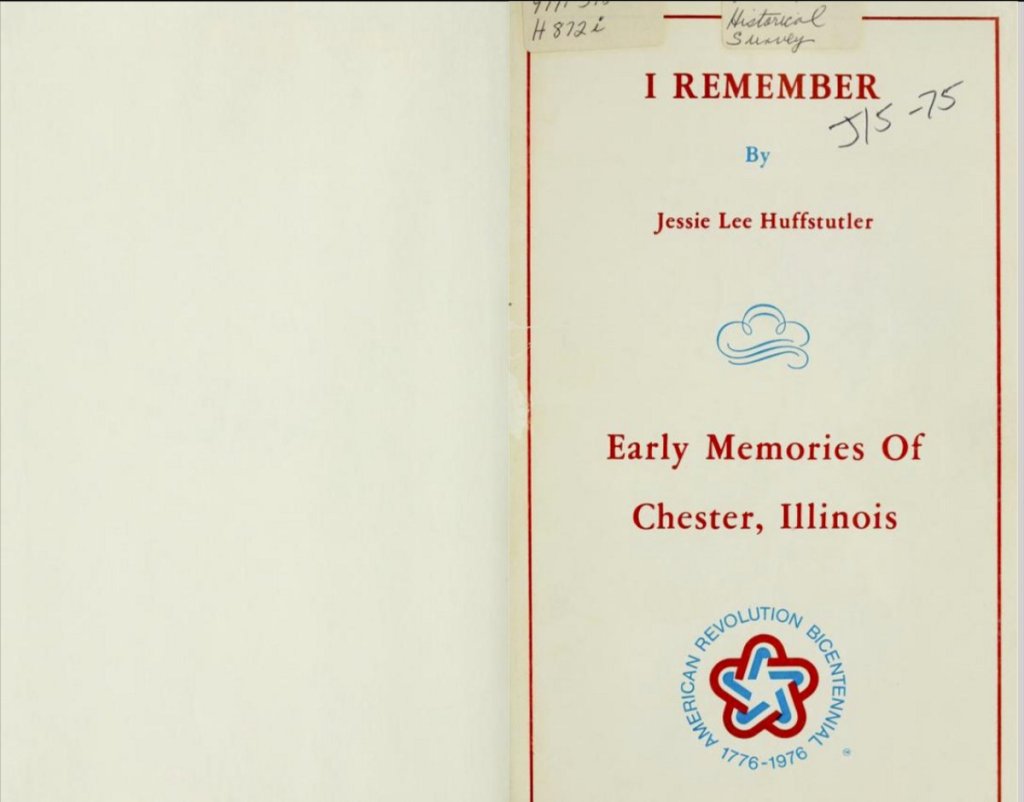
The unique memoir that Jessie produced is a particularly important window into the history of Chester and Randolph County in the early years of the twentieth century. In several sections of the book, Jessie retraces her steps along the main streets of Chester, remembering the buildings on each side of the road and the colorful citizens who inhabited them. For researchers and those more casually interested in history, the book is both valuable and entertaining. The memoir would go on to sell more than 1,000 copies, and it has been preserved and digitized today by the University of Illinois.
Jessie continued to live an active life in Chester into her 90s. In May 1980, at the age of 92, she passed away after a month-long illness. She was survived not only by her family—a daughter-in-law, two grandchildren, and a great-grandchild—but also by the students she mentored and encouraged in the classroom and the music room over the decades. Her desire to share her talents and knowledge with others continue stands as an example of dedication and service today.
Jessie Lee Huffstutler was inducted into The Randolph Society in 2025.
 The Randolph Society