A pioneering physician, public servant, and entrepreneur, Dr. George Fisher helped to lay the ground work for prosperity in Kaskaskia and offered valuable medical care to those who settled there.
George Fisher, the son of a blacksmith, was born in Virginia in the years just before the Revolutionary War. He was one of eight children raised in Hampshire County (now Hardy County, West Virginia). His father died when George was a teenager, leaving George’s mother, Christina, to manage a large family.
After reaching his majority, George received his inheritance. That money may have helped to fund his medical studies, which, according to family tradition, may have taken him to Germany for a period of time. Back in America, he settled down to begin his career as a physician and start a family of his own. He and his first wife, whose name appears sadly to be lost to history, had several children together, including a son, Jacob, and daughters Sarah and Elizabeth.
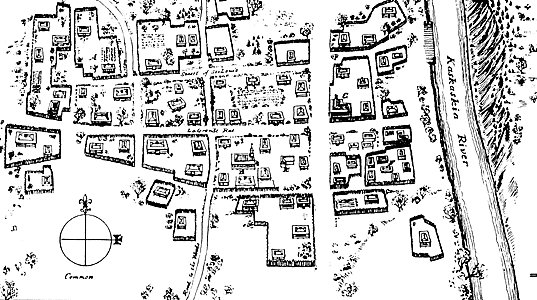
By the middle of the 1790s, with expansion pushing westward, George decided to move to the frontier. He arrived with his family in Kaskaskia in 1798 and quickly became a prominent member of the community. Professional medical care was a valuable commodity, and George began to serve as one of the first providers in the region. Contemporary accounts suggest that he married together newer scientific techniques with folk remedies as he saw local patients, including members of the extensive Francophone community that still dominated society in Kaskaskia at the turn of the nineteenth century.
John Reynolds, who spent part of his childhood in Kaskaskia and later became the fourth governor of the state of Illinois, wrote in his memoirs about the medical care that he received from Dr. Fisher: “The first medicine I ever took was from [Dr. Fisher], in the year 1801,” Reynolds recalled. He remembered George administering medications like tartar emetic, calomel and jalap, and quinine to cure “bilious fever,” a common symptom of malaria. Reynolds wrote that George was considered “the best of his day.” He characterized the frontier doctor as “a gentleman of common education” who was “a well-read physician” but “depended more on his natural abilities than books.” Reynolds remembered George’s “good, sprightly mind” and called him “an agreeable and benevolent man.”
George’s expertise and popularity led him toward other enterprises in Kaskaskia, too. When the Indiana Territory was officially organized in 1800, Governor William Henry Harrison appointed George to serve as sheriff of Randolph County. At the time, the county was the second-largest in the territory, with 1,355 people enumerated on the 1800 census. (The census did not count Native Americans, and there were still many members of the Kaskaskia tribe living in the region as well.) The new job took George across much of southern Illinois, as the county’s boundaries then included parts of present-day Randolph, Monroe, Perry, Jackson, Jefferson, Franklin, Williamson, Union, Johnson, Alexander, Pulaski, and Massac counties. But that population, and George’s day-to-day life, continued to be centered on Kaskaskia.
The influence that George gained, both through his political appointment and his medical knowledge, led him to develop additional business interests in the area. In September 1802, he was granted a license to operate a ferry across the Mississippi from Illinois to Missouri. The ferry was located six miles below Kaskaskia, not far from where Marys River joins the Mississippi. George continued to operate the ferry for at least three years. In December 1803, he was also given another business license, this time to operate an inn and tavern in Kaskaskia. The building, which became known as “Fisher’s Tavern,” was located on the main street in town. The two businesses would have offered George a steady, reliable means of additional income. Francis Philbrick, who wrote landmark texts on the laws of the Indiana and Illinois territories almost a century ago, noted that George’s business interests were part of the “extraordinary popularity” that he had achieved since moving to Kaskaskia: “To keep a ferry or a tavern was a certain sign of political favor. To be sheriff was to control politics.”
Details found in local records suggest that the money and influence helped George to support a growing family in Kaskaskia, which was also perhaps part of his growing profile within the French-speaking community. On New Year’s Day in 1804, George and his second wife, Catharine, arrived at Immaculate Conception in Kaskaskia with three small daughters, all of whom were presented for baptism. The ages of the girls, who were named Odille, Agathe, and Adelle, were not listed, but presumably all were under the age of six. Though George himself was not a Catholic, Father Olivier, the parish priest, performed the baptisms. All three of the girls had godparents from the local French community: Louis LaChapelle, Therese Bienvenu, Michel Danis, Marie Louise Bienvenu, Jean-Baptiste Seguin, and Marie Anne Bienvenu. Catharine, it seems, may have also been a member of a French Catholic family, suggesting that George may have married into the Francophone community like so many other Anglophones who arrived in Kaskaskia during the territorial era.
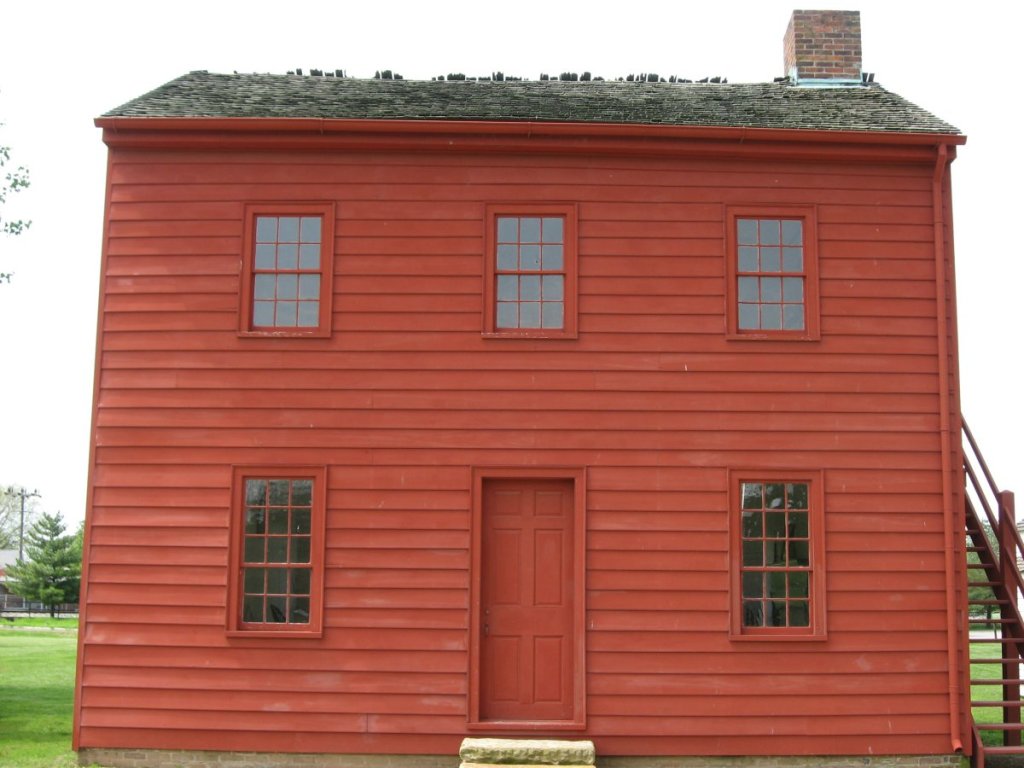
As George’s connections in Kaskaskia grew stronger, he was tasked with more and more responsibility within the territorial government. In 1803, he was named as a Randolph County commissioner, a role he held until 1809. When elections were held for the First General Assembly of the Indiana Territory in 1805, George was chosen as the sole representative for Randolph County in the House of Representatives. He traveled to Vincennes, Indiana, to be present for the first legislative session that July, alongside the county’s representative on the Assembly’s Legislative Council, Pierre Menard. He made the journey again in the autumn of 1806 for the second session, and then again in August 1807 for the first session of the Second General Assembly.
George found himself at the center of the political world of the town, the county, and the territory, and as a result, he began to reorganize his life at home in Kaskaskia. In 1808, he moved his family to a 500-acre farm, five miles away from Kaskaskia on the road to Prairie du Rocher, near the present-day site of St. Leo’s Catholic Church in Modoc. The area, which grew as others also established homes and farms in the vicinity, became known as “Dr. Fisher’s Settlement.” In an advertisement in the Western Sun, a newspaper published in Vincennes, George wrote in January 1808: “I am determined to move to the country in a few days, about five miles above this village, where I intend to reside for the future,” adding, “I will sell or rent my house in this village, where I now live, with about one hundred and fifty acres of good land in the publick [sic] field and near the town, with some fencing.” He also notes that anyone who rents the house can have access to “four beds, four tables a beaurough [sic], and a billiard table all in good repair, also one dozen of chairs.”
George and Catherine subsequently sold their tavern in Kaskaskia and moved permanently to their farm, but George continued to be a central part of the community, just as he had been for many years before. In 1806, he had been one of the members of the first Free Mason fraternal lodge established in Kaskaskia, serving as a junior deacon, and in 1807, he was appointed by the territorial legislator to serve on the town’s first board of trustees.
But unsettling change was on the way. Though he had largely retired as a practicing physician, George had to turn back to his medical roots when, not long after the Fishers settled on their new farm, an outbreak of smallpox began surging through the surrounding population. George set up a makeshift hospital on his farm. While other nearby settlements put up guards and barriers to keep out infected strangers, George decided not to turn away any person who needed help. Reportedly, much of the Francophone community, which had come to trust George over the years, sought treatment and advice from him during the outbreak, and many of them survived as a result of George’s care.
While George’s star was on the rise in politics, an unexpected promotion paved the way for tragedy. Pierre Menard resigned his seat on the territory’s Legislative Council, and George was selected to take over the seat. A special election was then called in the autumn of 1808 to fill George’s former seat in the House of Representatives. During the course of the contest, conflict developed between the eventual winner, Rice Jones, and Shadrach Bond, Jr., the future first governor of the state of Illinois. Rice Jones was the son of John Rice Jones, a prominent Welsh-born lawyer and politician who had previously served as the territory’s Attorney General and as a member of the Legislative Council.
Around the time of the younger Rice Jones’s election, disagreements between him and Bond intensified until they finally agreed to settle the matter in a duel. Bond’s second was Dr. James Dunlap, another physician who had set up a practice in Kaskaskia, while the merchant William Morrison was the second for Jones. No one was harmed during the duel, but in the weeks that followed, the rhetoric continued to ramp up between both sides. Fiery letters were published in the Vincennes newspaper, stoking anger until, in December 1808, Dunlap shot Jones on the street in Kaskaskia. Though he was indicted for murder, Dunlap left the territory and was not punished for the crime.
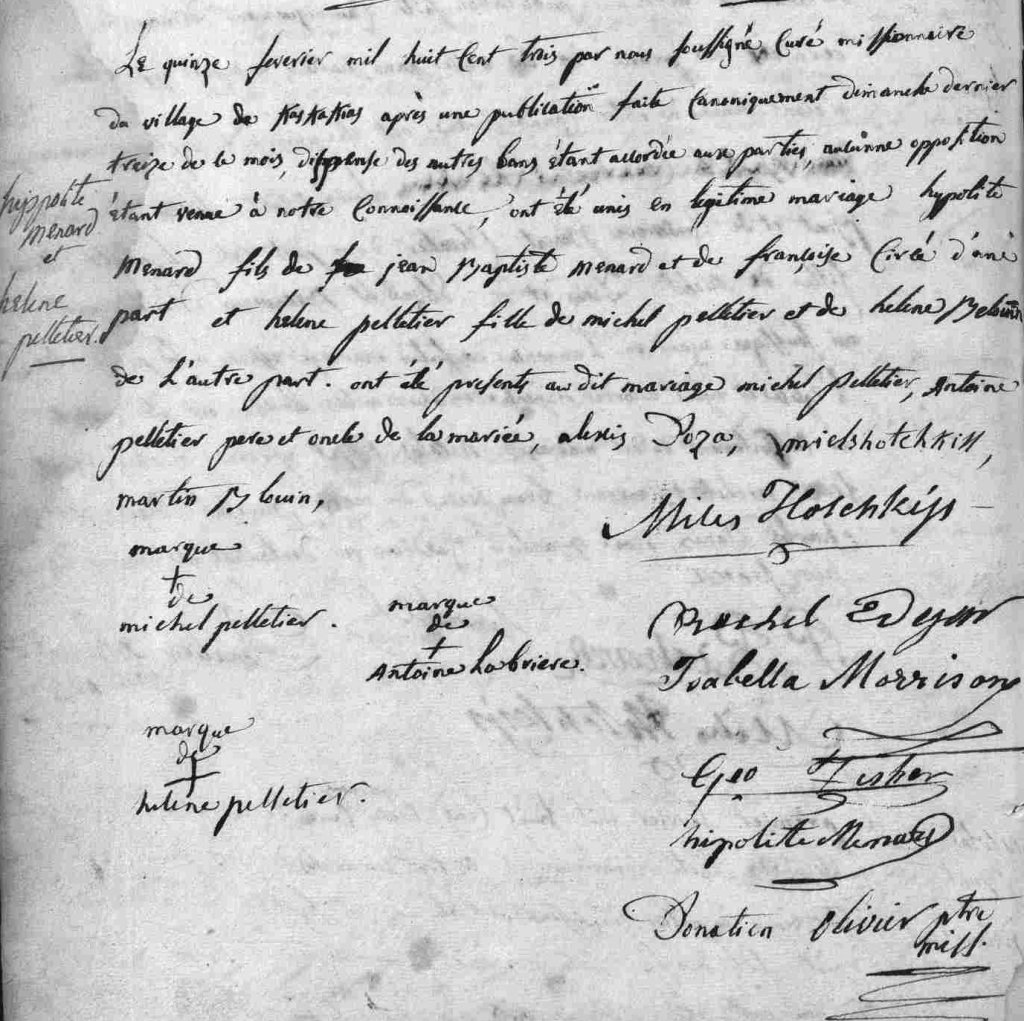
The sordid affair was just one part of the messy chapter of transitioning from territory to statehood. In 1809, the Indiana Territory was divided, and Kaskaskia became the capital of the new Illinois Territory. George was once again elected to the territorial General Assembly and chosen to be speaker of the House of Representatives. Though he now resided a few miles away from town, he was still an active participant in Kaskaskia society. In the winter of 1810, he served as one of the witnesses for the wedding of Hypolite Menard, Pierre Menard’s brother, and Helene Pelletier at Immaculate Conception, signing the register after the ceremony. He was also named as a judge in the new Court of Common Pleas in Kaskaskia in 1811.
For the next few years, though, George’s life was marked by natural disasters and war. In December 1811, the first of several strong earthquakes struck the New Madrid fault, causing significant damage in Kaskaskia. Aftershocks continued for several months, culminating in the strongest quake on February 7, 1812. A few months later, George found himself packing up his medical bag and heading into military service. He served as a surgeon in the Illinois militia, under the command of Colonel Hamnet Ferguson and Major Benjamin Stephenson (then sheriff of Randolph County), during the War of 1812. The militia traveled north along the Mississippi, fighting with Native Americans along their way north to Peoria. Hostilities ceased between the two sides by 1814, but the conflict would continue over the decades that followed.
Near the end of his life, George continued to be an influential figure in the shaping of the new state of Illinois. He was elected to serve as a member of the constitutional convention that framed the first constitution for the new state in 1818. He also ran for a seat in the new state senate, but was defeated—the first time he had suffered an election loss since moving to Kaskaskia two decades earlier. But there were happy moments for the Fisher family during these years, too. George’s daughter, Sarah, married George Dry on August 8, 1818. Her elder sister, Elizabeth, had married another local man, Spencer Adkins, and after his death would wed Gabriel Jones, the politician and postmaster who became mayor of Chester. George’s son, Jacob, had also married a local girl in May 1817: Drusilla Owen, daughter of George’s neighbor and colleague, Ezra Owen. They settled on a farm not far from George’s settlement before eventually moving to Arkansas.
The government of the new state was passing into new hands. George too was in a period of great transition. In February 1819, he sold a large parcel of land—at least 100 acres—in Kaskaskia to the new governor, Shadrach Bond. George settled down firmly into the life of a farmer on his settlement in Modoc, and there, in 1820, he passed away. He was buried on the property, which is now marked by a historical plaque celebrating his achievements. The settlement of George’s large estate was complex, with probate taking six years to complete. His son, Jacob, served as an executor, as did his sons-in-law, George Dry and Spencer Adkins. A family friend, Henry Conner of Prairie du Rocher, served as a guardian for George’s minor children during the proceedings.
Despite the uncertainties and dangers of life on the frontier, Dr. George Fisher fearlessly ventured out to care for patients in need, both in Kaskaskia and in the militia. His efforts within the territorial legislature, and with the constitutional convention, helped shape Illinois’s statehood and representative government. His example of public service, both on the county and state levels, stands as a challenge to all of us today, encouraging us to play a greater role in our own communities.
Dr. George Fisher was inducted into the Randolph Society in 2025.
 The Randolph Society