

A dedicated servant who spent decades working to improve the lives of visually-impaired people, Father Boniface Wittenbrink used his talents for leadership and community connection to build a world of wonder and joy through the radio.
Boniface Leo Wittenbrink was born in Evansville on June 30, 1914. He was the eighth of nine children born to Max Wittenbrink and his wife, Catherine Pautler Wittenbrink. Boniface joined older brothers and sisters Hilarius, Florentine, Raymond, Eleanor, Agatha, Wilma, and Cletus. Three years after his birth, the family was completed with the addition of his younger sister, Catherine. During his childhood, Boniface’s father, Max, worked in several different jobs, running a butcher shop, managing a saloon, and working as a farmer.
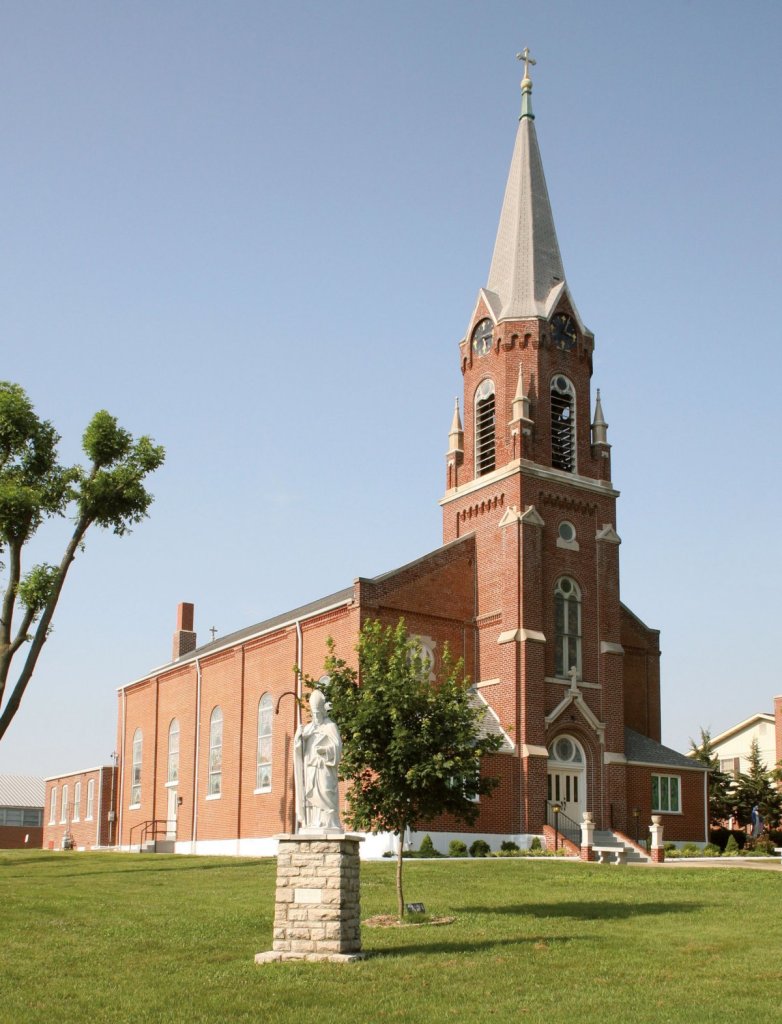
All nine of the children were raised in a community centered on St. Boniface Catholic Church. Max and Catherine Wittenbrink’s families–the Wittenbrinks, Wolffs, and Pautlers–worshiped at the church. They were married there, and their children were baptized at the parish. For the family, the local church felt like a second home, and early on, Boniface was particularly drawn to a religious calling. In a 2006 interview with the Progress Times, he reflected on a pivotal moment from his childhood that led him toward a career in the priesthood. In 1926, when he was twelve and attending school in Evansville, he learned that the local parish priest, Father J.B. Schlottmann, was retiring. Sitting at a pew during mass, he had a vision that he would follow in the retiring priest’s footsteps one day. Eventually, both he and his younger sister would commit themselves to a religious life.
Boniface embarked on his first steps toward fulfilling that vision three years later. He enrolled as a student at St. Henry’s Preparatory Seminary in Belleville in 1929. Run by the Missionary Oblates of Mary Immaculate, the seminary educated young men at the high school and college levels in its early years. A few weeks before his 21st birthday, Boniface graduated from the junior college at St. Henry’s on June 7, 1935. Bishop Henry Althoff presided over the ceremony. To continue his religious training, Boniface packed his things and headed to Mission, Texas, where the Oblates ran another seminary, La Lomita Novitiate.
After a year in Texas, Boniface embarked on an even greater adventure. On September 3, 1936, he boarded the Italian liner Rex in New York City, bound for Rome. There, he enrolled in a seven-year course of study at the International Scholasticate of Studies of the Oblates of Mary Immaculate to prepare him for the priesthood, with a focus on philosophy and theology. The college was filled with students from around the world, speaking more than 50 languages. Boniface worked hard during his time there to hone his own linguistic skills, becoming fluent in both Italian and French.
Only a few months after Boniface’s arrival in Italy, though, sad news came from home. On March 18, 1937, his father, Max Wittenbrink, died in a St. Louis hospital after years of suffering from painful neuropathy. Unable to make the difficult journey home for the funeral, Boniface mourned in Rome. More turmoil was on the horizon, this time thanks to mounting events on the world stage. In February 1939, Pope Pius XI died in Vatican City. Boniface was able to witness the funeral of one pontiff and the election of his successor, Pope Pius XII. He later told a reporter for the Evansville Enterprise that the new pope “certainly loves the American people and still talks about his visit to this country.” Boniface was among the thousands who crowded St. Peter’s Square to witness Pius XII’s coronation on March 12, 1939.
But though the matter of the succession to the papacy was settled quickly, there was increasing unease in Rome and throughout the European continent. On the day after the new pope was crowned, the German army arrived in Prague. Hitler had been annexing territory in Europe for months by that point. The Italian government, run by Benito Mussolini and the National Fascist Party, had signed a treaty with the Nazis shortly after Boniface had arrived in Rome. Boniface told the Enterprise about the “monstrous celebration” that Mussolini and his colleagues had thrown for Hitler during his visit to Rome in May 1938. Though Boniface had managed to stay away from the German dictator during his tour of the city, he often encountered Mussolini as he was driven from his home to work. It was difficult to avoid the “thousand bodyguards” that lined the route, Boniface told the local paper.
In his final year of studies in Italy, Boniface attended Gregorian University to take courses in sacred theology. He had planned for a much lengthier stay in the country, but when war was officially declared in Europe in September 1939, he realized that he would probably have to head home much earlier than he had anticipated. He and his fellow American students were warned that they should plan to return to the United States, but because Italy had not yet joined in the conflict, he stayed on to try to complete his studies. By May 1940, however, the warnings became orders. Officials from the American consulate directed Boniface to leave Italy immediately.
Boniface quickly booked his passage home to America, but first, he had one more important appointment to keep. Three days before leaving Rome, he was able to be present for a public audience with Pope Pius XII. The pontiff blessed Boniface’s cross and offered him a special blessing for his widowed mother, Catherine Wittenbrink. Boniface told the Evansville Enterprise that, during the audience, there were many Italian soldiers in the crowd who beseeched the pope to pray for peace. In his interview with the Enterprise, Boniface emphasized that “the Italian people shouldn’t be blamed for their country going to war.” That blame, he stated, should be placed squarely on the Fascist party that was at the head of the Italian government. “Hitler was playing the music,” Boniface said, “and Mussolini jumped on the band wagon.”
After boarding a train in Rome on May 30, 1940, Boniface arrived in Genoa, where he waited for two days before he could board the SS Manhattan, the ship that would take him back to America for the first time in almost four years. The ocean liner sailed on June 2, 1940, with almost 2000 passengers crammed on board. Among these were more than 300 priests, nuns, and seminary students. After an eventful eight-day ocean crossing, during which a baby was born and an elderly passenger passed away, the ship arrived in New York on June 10. It turned out to be a very close call. Boniface recalled that the ship passed by the Statue of Liberty just as Mussolini was officially declaring war back in Italy.

Back in North America, Boniface prepared for his ordination. On September 20, 1941, his friends and family gathered at St. Boniface in Evansville to watch their son, brother, and friend become a priest. He was ordained in his home church by Bishop Henry Althoff of the Belleville Diocese. The Belleville Messenger called the ordination service a “function which will live long in the memory of the parishioners of St. Boniface Church.” Also ordained that day was Father John S. Walsh of Tipton in Monroe County, who had been one of Boniface’s classmates at St. Henry’s Seminary.
During the ordination ceremony, Bishop Althoff noted, “This is a solemn and blessed occasion. It is a day which the Lord has made, a day forever memorable because it marks an event of religious significance, the ordination of two young men to the holy priesthood. Coming from pious homes they followed in their youth the call to the service of the Church. The parishes from which they come, St. Boniface, Evansville and St. Patrick’s, Tipton, justly rejoice at the distinction attained by their sons, and we felicitate them. It is especially St. Boniface Church that we see decked in festive attire and exhibiting marks of joyous participation in this solemnity.”
More education was ahead for Father Boniface, who was often simply called “Father Boni” by friends and colleagues. He completed his theological studies in Ottawa, Canada, in 1943, and he subsequently studied at the University of Chicago and the Catholic University of America in Washington, D.C., earning a master’s degree in 1947. In turn, he also became an educator himself. He returned to St. Henry’s Seminary in Belleville as a faculty member in the 1940s. Later, he moved to Carthage, Missouri, where he was registrar at Our Lady of the Ozarks College.
In the middle of his educational pursuits, Boniface also made time to take part in some very special family moments. He officiated the wedding mass for his brother, Raymond, and Dorothy Lonergan at St. Augustine Catholic Church in the Hyde Park neighborhood of St. Louis on June 26, 1943. Indeed, Boniface was able to participate in many of his family’s religious celebrations over the years. He was an altar server when his eldest brother Larry married Marie Cragan at St. Boniface in Evansville in 1933. At the same church in the autumn of 1974, he presided over the funeral mass for his mother, Catherine. Boniface’s older brother, Cletus, gave his son the name Boniface in honor of Father Boni. The younger Boniface followed in his uncle’s footsteps, entering the priesthood in 1963. By that time, taking orders was a family tradition. Catherine, the youngest of Boniface’s eight siblings, had joined the Franciscan Sisters of Mary in 1934, taking her final vows as Sister Mary Dorine in 1940. A trained nurse, she became known as the “Preemie Sister” for her dedicated and innovative work in caring for premature babies.
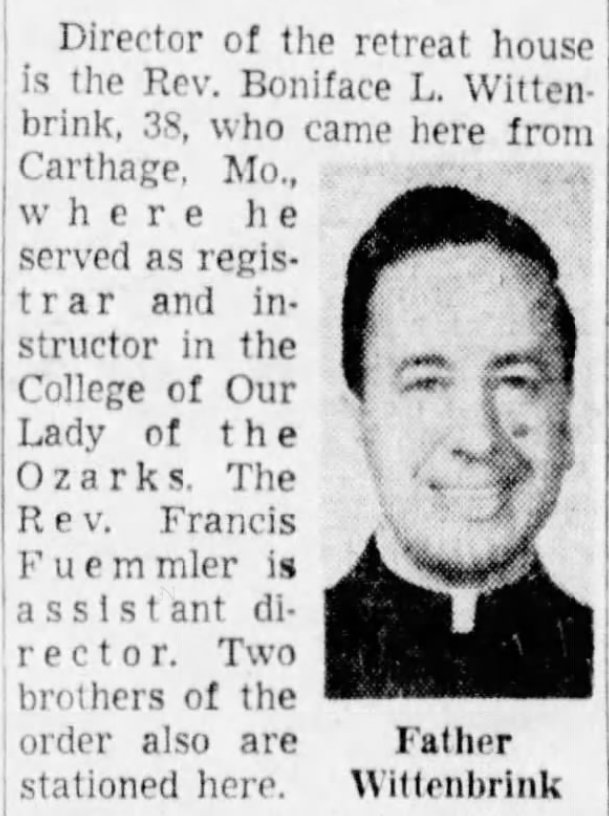
Father Boni continued his career as a Catholic educator for many years, serving in parishes from Minnesota to California. The leadership skills he developed in that profession made him particularly suited for his next role as the organizer and leader of meditative retreats. He traveled across the country to guide religious retreats in Catholic parishes and centers, and in 1952, he became the director of King’s House, a lakeside retreat center in Buffalo, Minnesota. Many of the retreats led by Boniface were open not only to Catholics but also to members of the general public who wished to take part. Attendees at these retreats were able to take a brief refuge from the pressures of the outside world, spending their time reading, praying, listening to lectures, and meditating.
In the 1960s, Boniface found himself in Washington, D.C. There, he served as the permanent secretary of the Conference of Major Superiors of Men, a national association founded in 1956 to represent male religious institutes, monastic communities, and societies of apostolic life. In his role, Boniface often found himself speaking about religious communities with the press at a time of great change for the Catholic church. He also became passionately involved with the anti-war movement of the era, protesting alongside the actor Paul Newman against the Vietnam War.
Boniface was in his late 50s when he moved back to Illinois and discovered the vocation that would come to define his life. In February 1972, Boniface was called by the superiors of his order to go to the Shrine of Our Lady of the Snows in Belleville, Illinois. There, he was tasked with developing and managing a new initiative known as the Radio Talking Book. The Belleville Messenger wrote that in his new role Boniface would “be exploring the possibilities of establishing informational, educational and entertaining broadcast programming for the blind and physically handicapped of the area,” transmitted via the Shrine’s radio station, WMRY. The programming would use the resources of the Talking Book Program of the Library of Congress and would be based on similar successful projects in places like Minneapolis and Lawrence, Kansas.
The idea for the program had been sparked by a suggestion made by a local radio sales manager, Tom Heapes, to the general manager of WMRY, Byron Bellville. Thousands of visually-impaired men and women lived within the station’s broadcasting radius. An article in the St. Louis Post-Dispatch explained the need for the audio resources: “Only one out of 30 blind persons can read Braille. The Library of Congress supplies recordings of books to the blind […] and so does the St. Louis Public Library. But newspapers and magazines are not available.” Even when a popular book became available on tape, demand for the physical tapes quickly outpaced supply.
Father Edwin J. Guild and Father Tom Woestman, founder and director of the Shrine, presented the talking book idea to Boniface when he attended a retreat at the facility. “I had worked in the realm of ideas, on government affairs and in the field of Bible translation,” Boniface told the Post-Dispatch in August 1972. “I had never worked with the blind and knew nothing about radio programming. However, Father Woestman talked me into it and I agreed to stay as a member of the staff.”

Fundraising was one of the most important early concerns, as money was needed to produce special radio receivers that could be loaned to visually-impaired listeners and to cover the costs of operating the station and securing necessary equipment. Boniface dreamed up a fundraising campaign that he called the “Committee of One Thousand”: a thousand volunteers tasked with raising just $100 each. It was part of an overall goal to raise $100,000 to support the initiative. Boniface made the rounds speaking to various civic organizations and charitable groups to promote the venture, and the St. Louis Cardinals agreed to donate a portion of ticket sales from a Cards-Phillies game at Busch Stadium toward the cause.
Boniface was also hopeful that federal funding support might be forthcoming. “I am convinced we are going to get some federal funds for the project, which is strictly nondenominational and has no religious overtones,” he explained. Indeed, though the project was a part of the mission of the Shrine, there was a clear understanding that it was not an evangelizing operation. “We’ll give them the news in depth,” Byron Bellville explained. “We’ll read editorials and columns from the St. Louis newspapers, the New York Times, and other papers. We won’t read the newspaper cover to cover but we will present news analysis articles, news in detail and feature articles.” Articles from popular magazines like Time and Newsweek would also be featured, as would books, both classic and new publications, read in their entirety. “If we read a book, we won’t edit it,” Bellville promised. When the Post-Dispatch reporter pressed Boniface about popular contemporary books with more adult content, like The Godfather, he laughed. “I’ll have to defer an opinion,” he replied, adding, “I read The Godfather and I liked it.”
Though he lacked any background in radio, Boniface was able to shepherd the program quickly through its initial stages. One of his biographers, Raymond M. Heinen, noted that Boniface “was able, within ten months, to obtain Federal Communications Commission approval and a broadcast channel,” plus “an endorsement from the Federal Office of Telecommunications.” Donations came in, big and small, from those who wished to help. An army of volunteers, made up of both professional broadcasters and regular citizens, was recruited to record themselves reading the content that would be broadcast for blind listeners. The special receivers were ordered, manufactured, and delivered. And on March 1, 1973, the Shrine’s Talking Book officially went live.

Initially, 100 listeners were selected to receive the special receivers so that they could listen to the programming, which began every morning at seven o’clock and continued until 10 PM. The sets were provided to the recipients as loans at no cost. Those who wished to pay, Boniface said, could simply make a donation to the Shrine. Almost immediately, there were plans to expand. The Associated Press published a profile on the Talking Book project in July 1973, and Boniface revealed that they were already in the process of expanding soon to 500 available receivers, with more than a thousand provided to listeners by the end of the year. Boniface continued to serve as the charming public face of the program, always happy to attend a dinner or function to explain the benefits of the project and accept any offered donations.
A year after the Talking Book was launched, the project was thriving. “I still have a lot to learn,” Boniface replied when one newspaper reporter asked him about the success of the initiative. Volunteers continued to regularly offer their time to read newspapers, books, and magazines, either at the radio station or in home studios. The Belleville News-Democrat wrote, “They range in age from 17 to 68. People from all walks of life have become involved. They are lawyers, legal secretaries, students, a retired lady lieutenant colonel, housewives, salesmen, school teachers, and many retired persons.” Father Boni even hosted his own popular daily radio show, called Talkback, on the airwaves every afternoon.
Over the years, the stable of volunteers expanded with the program. Those who had particular gifts as readers were especially valued. One such reader, a former priest named Colin Havard, had a particularly notable voice. Though he had lived in St. Louis for years, he was originally from England, and he read his assigned texts in a pleasant British accent. But while a lovely voice was a plus, it wasn’t a requirement. Dolores Conrad, who served as secretary for the project, explained, “We check everyone out to see if their voice has good air quality–if they sound good over the radio. But we never turn anybody away. We find a place for everybody. All we need is your time.” That time was precious indeed. The station received volumes of enthusiastic feedback from the visually-impaired people who listened to the programming on their receivers each day. “I enjoy the reading of the newspapers so much,” one listener wrote. “It’s nice to hear news that is up to date.” Another listener shared, “I am well aware of the effort involved on the part of each individual and sincerely hope they know how deeply grateful their listeners are.”
The work of Boniface and the project staff certainly did not go unnoticed. Throughout his time as the program’s executive director, Boniface gladly reached out to provide help to other radio projects for visually-impaired listeners, including an early initiative in nearby Chicago. At a state convention held by the Illinois Federation for the Blind, Boniface met a couple from Carbondale, Rick and Valerie Parrish, who were inspired to start a radio project for blind listeners on the campus of SIU Carbondale. By the year 2000, there were 148 dedicated radio stations for blind listeners across the nation. Boniface traveled extensively both across America and abroad to promote increased access to audio content for blind listeners. He served on the Radio Educational Committee of the American Council of the Blind and the Radio Talking Book Committee of the American Foundation of the Blind, and he also worked with the Library of Congress and the Department of Health, Education and Welfare. He offered his growing expertise in the field to several national congressional committees, and through a state grant, he established Illinois Radio Information Services.
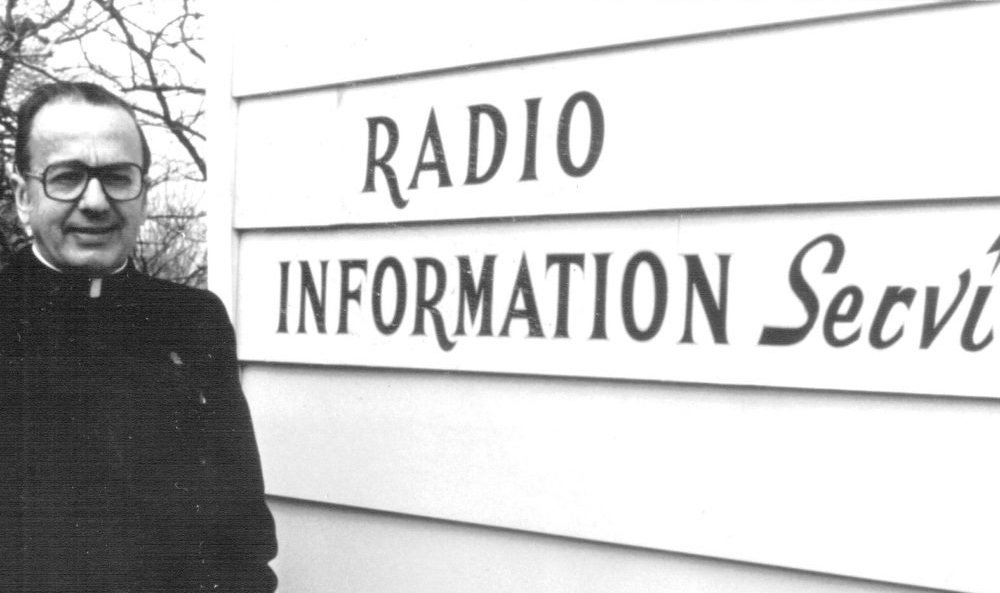
As technology evolved, so did the radio initiative at the Shrine. In 1983, as the project celebrated its tenth anniversary, it had changed its name to the Radio Information Service (RIS) for the Blind and Handicapped. Thousands of eligible listeners in the St. Louis area now had access to its broadcasts via the provided receivers. RIS was always searching for new ways to reach listeners, including a project to install receivers in nursing homes for residents to access. In a 1984 profile, the Post-Dispatch interviewed Robert Leighninger, the executive director of the St. Louis Society for the Blind (and an RIS volunteer). He noted, “What RIS does is present the kind of timely information that if it were put into Braille or on tape it would be out of date.”
With the advent of the internet and the increased availability of new digital audio content, the Radio Information Service might have been concerned that it would face obsolescence. But 50 years after it was established, the program has endured. Now called MindsEye, the program’s offerings have continued to expand. Listeners are now able to access coverage via web streaming, podcast apps, and smart home devices. Tapping into the wide network of radio services for the visually impaired that has grown over the past half century, MindsEye listeners can also access content produced by other stations as well. MindsEye has also developed new initiatives to connect with visually-impaired community members, too. Among these is an audio description program that allows those with visual impairments to more fully experience films and plays. And, going beyond the world of audio production, the organization now includes an adaptive athletics program, promoting community connections on the field in sports like BeepBall and Goalball.

Boniface worked with the staff at MindsEye and the Shrine until his retirement in 2009. Over the years, his work with the program was recognized with numerous awards. In 1974, Boniface received the Kiwanis Medallion, a prestigious national radio award, for his early work with the Talking Book. A decade later, in 1983, he was elected president of the board of directors of Friends of Eye Research. In 2000, he received the prestigious Agrama Harmony Gold and Light Award from the Retinitis Pigmentosa International organization. The award was bestowed on him for his “compassion, dedication, and innovative vision” in his work to improve the lives of blind and visually-impaired people. His lifetime of service was recognized in 2011 with the C. Stanley Potter Emeritus Award from the International Association of Audio Information Services. In 2018, he was posthumously inducted into the St. Louis Media Hall of Fame.
Boniface likely could never have imagined that he was helping to build a service that would ultimately become a crucial part of his own daily life, too. He retired at the remarkable age of 95, largely because he had lost his own sight. For the next nine years, until he died in June 2017–a few weeks before his 103rd birthday–Father Boni was able to experience the world through the voices of the volunteers and staff members at an organization he had developed and nurtured. His legacy was indeed one of his final rewards.
Throughout his remarkable life, Boniface was dedicated to bettering the lives of others not only spiritually but also through education, community connection, and access to information, culture, and entertainment. In his eulogy, delivered during Boniface’s funeral at Our Lady of the Snows in Belleville, Raymond W. Heinen inspired those present to follow in Boniface’s footsteps: “Father Boni, our world is a better place because of you. Your work will endure and may your reward be great in heaven. My friends, we will all miss this solid contributor of America’s Greatest Generation. Let’s all reflect on what our contributions have been and might be.”
Father Boniface Wittenbrink was inducted into The Randolph Society in 2024.
 The Randolph Society