

A pioneering architect who opened doors for women in her field, Alberta Raffl Pfeiffer used her talents to design remarkable homes for New England residents–and to better the lives of the people in her community through her philanthropic work.
Alberta Raffl was born in Red Bud on September 17, 1899. She was the second child and first daughter born to Albert Raffl and his wife, Johanna Rau Raffl, joining an older brother, Arthur. Three more children–Elisabeth, Rosalia, and Claude–completed the family by 1911. Albert Raffl was the son of Austrian and Swiss immigrant parents who had settled in Illinois in the 1850s. His father, Chris Raffl, was a cigar maker. Chris opened a factory in Red Bud, starting a family business that would endure for more than half a century.

By 1898, just before Alberta’s birth, the Raffl family was operating a cigar factory in Red Bud under the name C. Raffl & Sons. Chris and his sons, Albert and Oswald, headed up an enterprise that produced more than 300,000 cigars that year. In 1900, Albert purchased the factory from his father, continuing to oversee its operations in Red Bud for the next three decades. Ten years after he acquired the business, the factory was producing more than half a million cigars every year under labels like “Major Reno” and “Al’s Best.”
Early on, young Alberta nurtured a deep interest in art and design, noting that she always preferred playing with blocks over teddy bears and dolls. She was deeply influenced by the traditional crafts and treats made by her Swiss grandmother. A 1953 profile published by the Hartford Courant noted that Alberta maintained that there “will always be a place for simple, well-designed crafts,” a belief that had its roots in her grandmother’s kitchen. The paper noted that Alberta recalled watching “her grandmother make ‘springerle’”–traditional Swiss Christmas cookies–”back in Red Bud, Illinois, around 1912.” The profile added that “there was a second pleasure for the little Alberta in the carved wooden cookie-cutting board, which had come from Switzerland. When it hung on the kitchen wall, she recalls, it was a spot of clean beauty in a ponderous Victorian setting.”
Alberta’s visual acuity, developed at a young age, would later lead her to a career creating beauty in hundreds of American homes. The success of the family cigar business allowed Albert and Johanna Raffl to raise their children comfortably in a home on Market Street in Red Bud. The couple valued education, and remarkably for the time, they were able to send all five of their children–sons and daughters–to college after they graduated from high school. Both of Alberta’s brothers went to medical school and became practicing physicians. She and her two sisters all enrolled as students at the University of Illinois.

Alberta arrived on campus in Champaign in the autumn of 1919. She was part of one of the first post-war classes at the university, and the return to school after a stint as a draft board secretary in St. Louis was a breath of fresh air. She enrolled with a freshman class at the university that also included several other students from Randolph County, including Elizabeth Brown Hood of Sparta. Alberta joined a growing community of female students at the university, and she quickly found a home in the academic environment there. She had enrolled as a student in the Department of Architecture at the School of Engineering, part of an architecture cohort that included just nine women.
At first, the prospect of being one of the only women in her surroundings was daunting. “I had no idea when I stood in line to register at the College of Engineering [that] there were no girls in line,” Alberta remembered decades later. At a time when the nineteenth amendment still hadn’t been ratified, she had to overcome significant gender bias on the part of both her fellow students and their instructors. “Some of the men tried to get rid of her,” a reporter noted in 1977, “and a design course instructor refused to criticize her work.” But there were also male students who were unbothered by the idea of having female colleagues, including some “older male students [who] taught her to use a T-square” in her first days in drafting classes.
Though she faced obstacles, Alberta ultimately thrived at Illinois, joining committees that organized festivals, picnics, and mixers. She was a member of the YWCA, the Architecture Society, the Columbus Foundation, the Alethenai Women’s Literary Society, the Cosmopolitan Club, and the Illinae Women’s League, serving as president of several of organizations. By her junior year, Alberta was part of the university’s Big Sisters Committee, which provided guidance and mentorship to women who had newly enrolled at the university. She also used her artistic talent to put on popular “chalk talks” for different groups. The 1924 Illio yearbook featured her pencil sketches of various buildings around campus.

When Alberta graduated from the University of Illinois in 1923, she was first in her class. She was one of just four women graduating in a class of 250 students from the School of Engineering, and just the thirteenth woman to graduate from the department of architecture since its establishment in 1873. Her unique and special architectural talent was singled out for numerous accolades in her graduation year. April 1923, Alberta won first prize in the Beaux Arts Institute of New York architectural contest, earning a gold medal with her submission, “An Italian Palace Façade.” And then, a few weeks later, her time at Illinois was crowned with an even greater honor.
On May 7, 1923, Professor L.H. Provine, head of the Department of Architecture, announced that Alberta was the winner of the 1923 medal of the American Institute of Architects. Awarded to the top student at each of the nation’s fourteen architecture schools, the Daily Illini noted that the medal was “awarded to the senior who does the best all-around student work for four years,” recognizing the student with “the highest scholarship and professional standing.” Alberta was the very first woman to receive the prestigious honor at any American university.
Alberta’s professional career continued to soar after she received her degree from the University of Illinois. A few weeks after graduation, her work was published in the June issue of the American Architects and Architectural Review. She was quickly hired to work for the Tallmadge & Watson architectural firm in Chicago. But a year later, she found herself back in Champaign once more. She was hired as an instructor in the department of architecture, succeeding the retired Professor C.A. Kissinger. For the next several years, she was an active member of the department, teaching, doing graduate work, and mentoring a talented slate of architects that included another outstanding female student, Mary Worthen.

During her time as a student and a teacher at the University of Illinois, Alberta met the person who would become her most lasting partner in both life and work. Born in 1896 in Kansas, Homer F. Pfeiffer served in World War I and attended community college in Kansas City before enrolling as an architecture student at the University of Illinois. Homer was a talented artist who also became a skilled architect. Like Alberta had two years earlier, Homer received a medal from the Beaux Arts Institute of New York in May 1925. He also won the medal of excellence given by the American Institute of Architects in 1925. After graduation, he headed to Yale as a graduate student and instructor, but in 1928, he won a prestigious fellowship that included several years of residency in Rome. There, in 1930, Homer and Alberta were married. Alberta’s relationship with “Pfeiff” was at times a rocky one–including a period of divorce and remarriage–but it was also a fruitful and creative professional partnership.
After their wedding, Alberta and Homer returned to America, where she had been working with the firm of Harrie T. Lindeberg in New York for several years. The Hartford Courant noted that Lindeberg was “one of the country’s leading residential architects, specializing in million-dollar homes.” She first applied for a position with the firm in 1925, and just as she had at Illinois, she faced some initial pushback where questions of sex and gender were concerned. “We aren’t set up to have any ladies in the drafting room,” she remembered one colleague protesting. There wasn’t even a dedicated restroom available for the small number of female secretaries working for the company.
As the only female architect employed by the firm, she recalled that her male colleagues were nervous at first about how they were expected to behave in her presence. “For three days they were so careful. I thought, ‘Well, they don’t use any bad language or anything.’ Then they began to say a bad word now and then, and I didn’t fall over dead, so they kept on,” she remembered. Soon enough, they grew to respect Alberta for her talent–and, she noted, for the fact that she smoked and drank bootleg gin just like they did. Her success at the firm paved the way once again for more women to join the profession, and Lindeberg began hiring additional female architects.
Alberta saw the excellent craftsmanship used in elaborate residences first hand during her tenure with Lindeberg. She worked on homes, estates, and country houses owned by members of several prominent families, including the Astors and the Vanderbilts. She was even on the team that did work on a splendid clubhouse for the Asheville Country Club in North Carolina. The lessons she learned while working with Lindeberg would color her work for decades to come–but she would later describe New York as a place where “there is much more money, and where many, many architects have ulcers.”
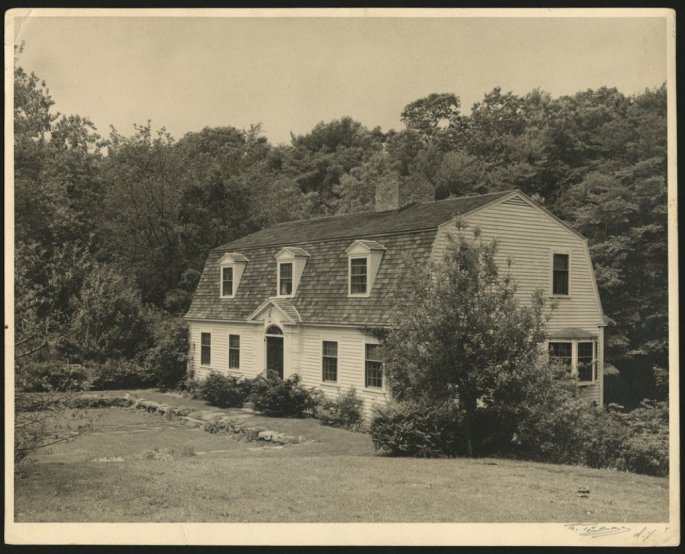
A quieter life awaited. In 1931, Homer resumed his teaching career at Yale, and the Pfeiffers moved together to Connecticut. They settled at 64 Mitchell Hill Road in Hadlyme, a historic neighborhood within the towns of Hadden and Lyme, in a 1789 colonial farm house nestled in acres of woodland. The Hadlyme district features numerous homes and buildings in the Georgian and colonial styles, places that provided plenty of inspiration for both Homer and Alberta as they worked on projects in the area surrounding Lyme. Some estimates suggest that they may have contributed to more than 200 homes, including many historic residences, both in Connecticut and elsewhere.
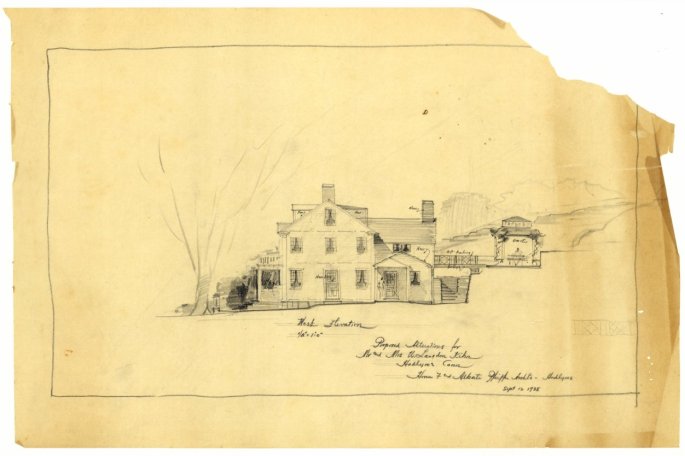
The years between and after the wars represented the most prolific period of Alberta’s career. Working in a private practice out of her home, she honed a style that would come to define her work. A 1977 profile in the New London Day noted, “The hallmark of Mrs. Pfeiffer’s style was simple elegance. ‘I’ve always done plain houses,’ is the way she describes her style. But in photograph after photograph of houses she designed, a fine eye for detail and balance are evident. One of her specialties is a graceful, curving staircase. Other items that appear in her work are corner cupboards and wood paneling with fine carved work.” Clients from New York continued to seek out Alberta’s design services, often traveling to her Connecticut home for consultations.
When World War II dawned, Homer decided to reenlist in the navy. Back home in Connecticut, Alberta turned her attention to the arts on the home front. She became deeply involved with the craftsman movement in the state. Her interest was piqued during the annual Christmas sale in Hadlyme, where local men and women sold their homemade arts and crafts pieces–everything from braided rugs to carved furniture. She would go on to become the founder and editor of the Connecticut Craftsman, a magazine that she ran from an office in her home. She was also a member of the Society of Connecticut Craftsmen, a lifetime member of the Connecticut Society of Architects, and a member of other professional organizations.

Just as she had during her college years, Alberta devoted much of her spare time to local organizations and causes. She served on the board of the Connecticut Valley Mental Health Association for 25 years, and she was an active volunteer at the Norwich State Hospital. There, she spearheaded a special project to bring a little joy to the lives of patients at the hospital. For decades, she organized the collection of cakes from local residents, which were frozen and used for monthly birthday parties celebrating senior patients. The project also took donations of boxed cake mixes and frosting, which were used by younger patients as part of a baking therapy initiative. Alberta’s memories of Christmas joy in her grandmother’s kitchen were transformed into projects to extend that holiday happiness to others who needed it most.
Though she did not have children of her own, Alberta was also dedicated to the education and wellbeing of the children in her local schools. She was a member of the school board for many years. She also held lessons in various arts and crafts, including sewing and jewelry making, for young people who wished to learn. Active in numerous civic causes, she served her community on planning and zoning committees, was elected to the town committee, and even spent two years serving as a justice of the peace.
Alberta largely retired from her architecture practice in the 1970s, though she occasionally took on rare commissions in her later years. She spent her retirement enjoying her home, tending to her gardens and landscaping. Both she and Homer also spent time on artistic pursuits like painting and making silver jewelry. Homer even planted a vineyard of hybrid French grapes in the couple’s backyard.
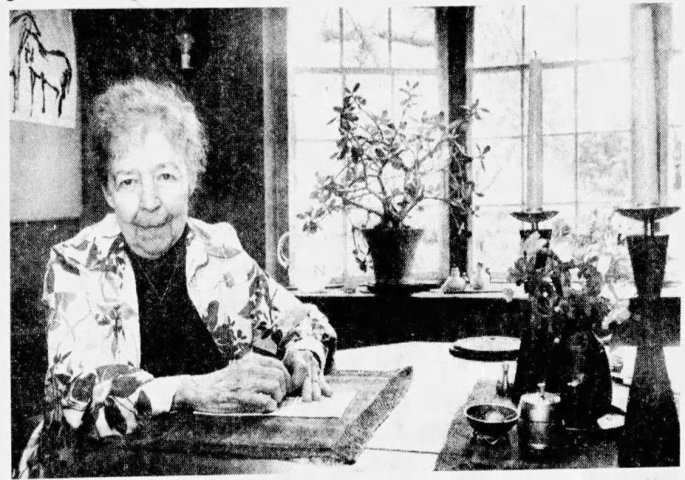
In the last decades of her life, Alberta was particularly sensitive to the needs of the elderly people of her community. She was one of the driving forces behind the creation of a telephone “reassurance” line for senior citizens who were living alone. She called the effort “a heartwarming experience.” Indeed, so much of Alberta’s life was centered around making warm places–comfortable homes, safe communities, inclusive schools, happy celebrations–for the people she loved. She earned a living designing and building beautiful residential spaces, but she was keenly aware of the need to fill those houses and their surrounding communities with love, reassurance, kindness, and comfort. She knew that a beautiful house was only good once it truly became a home.
Alberta passed away in Connecticut on August 5, 1994, just a few weeks before her 95th birthday. She was survived by her youngest sister, Rosalia, and by her stepchildren. A trailblazer who opened doors for countless women in her profession, Alberta once reflected on her remarkable life with typical modesty. “I’ve had quite a few things happen to me,” she mused. “Since I have done what I really wanted to do and enjoyed most of it, I’ve been very fortunate.” The people in the communities on which Alberta left her mark may have been the truly fortunate ones.
Alberta Raffl Pfeiffer was inducted into the Randolph Society in 2024.
 The Randolph Society