Don and Margret Wiley inducted into The Randolph Society

Don and Margret Wiley

The Randolph Society Foundation Board is pleased to announce that Don and Margret Wiley, historical preservationists and educators, will be inducted into the 2025 class of honorees.

Margret Baue Wiley was born at her parents’ farmhouse in rural Sparta in 1927. Her family had deep roots in Randolph County, and that family history was fascinating to Margret from an early age. With her younger brothers, she attended the Goddard School, a one-room schoolhouse located about a mile away from the family farm. She developed a love for learning, as well as a passion for the traditional skills and crafts that she picked up while growing up on the farm. She and her brothers often played with children who lived on nearby farms, including the boys of the Wiley family.

One of those neighbor boys, Donald Wiley, was born in Jacksonville, Illinois, in 1934. With his parents and brothers, including his twin, Ronald, Don moved often while his father worked as a traveling salesman. Eventually, though, the Wileys moved back to his father’s native Sparta, settling just a quarter mile from the Baue farm. Both the Baue children and the Wiley twins were active members of the local 4-H Club, and all of them attended Sparta Township High School as they grew into teenagers.

After graduation, Margret spent a term studying at SIU Carbondale before entering the working world. She worked at the Brown Shoe Company’s manufacturing facility in Evansville before taking an office job at the Mallinckrodt Chemical Company in St. Louis. Meanwhile, Don also graduated from Sparta High and attended a few classes in Carbondale before starting work as a carpenter.

Eventually, Don and Margret’s friendship developed into romance. They were married at Trinity United Presbyterian Church in Sparta, where both families worshiped, on January 22, 1955. Soon after, Don was drafted into the army, and the young couple moved first to Texas and then to Washington, D.C. There, Don had an office job at the Pentagon, and as both he and Margret were history lovers, they relished the chance to take in the monuments and museums during their time in the nation’s capital.

In 1958, the couple settled down in a home south of Sparta, where they raised their children, Kerry and Lee Ann. Don started his own carpentry business, taking on handyman work and building and repairing furniture. Margret joined the local Home Extension organization and served as an election judge in Sparta. Both of them also lent their talents to numerous local clubs and societies, including the Randolph County Historical Society.

Margret loved reading and researching about history, and Don loved experiencing the past through reenactments. Together, they helped to establish an antique rifle shooting club, a pursuit that would become the cornerstone of the Rendezvous held annually at Fort de Chartres. They were very involved in the annual Corn Fest fundraiser at the nearby Charter Oak School House, providing historical demonstrations like broom making and candle dipping.

In 1976, Don organized a group to retrace the path traveled by George Rogers Clark when he captured forts in both Kaskaskia and Vincennes during the Revolutionary War. He and his fellow Long Knives members trekked on foot as they followed Clark’s path on the 185-mile journey, which was timed to coordinate with the national bicentennial celebrations. Margret and Kerry provided crucial support during the journey, which took more than a week.

The Clark reenactment trip was emblematic of Don and Margret’s love for history and their desire to share it with generations to come. Both Margret and Don continued to be active members of their community until their passings in 2004 and 2011. Their efforts continue to echo through the county’s historical landscape today.

Click here to read a more detailed biography of Don and Margret Wiley.
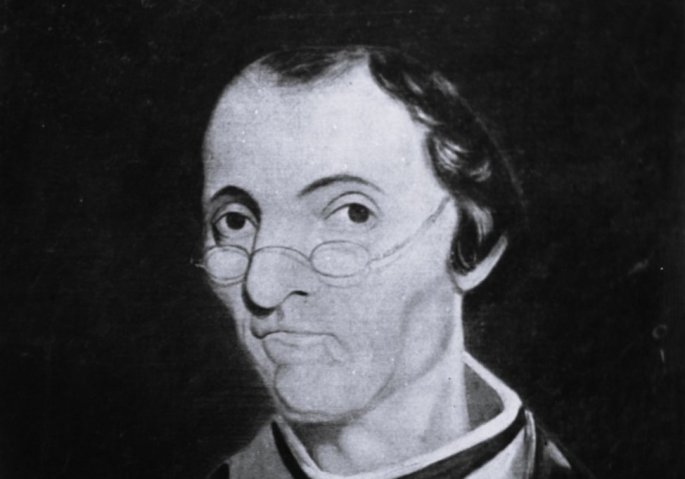
Father Gabriel Richard inducted into The Randolph Society

Father Gabriel Richard

The Randolph Society Foundation Board is pleased to announce that Father Gabriel Richard, a priest, educator, and public servant, will be inducted into the 2025 class of honorees.

Gabriel Richard was born in France in October 1767. He was one of six children born into a family with ties to the nation’s powerful Catholic leaders. When he was just eleven, Gabriel enrolled as a student at a local college, where he distinguished himself as a talented scholar. As he matured, he decided to enter the Sulpician seminary in Angers. There, he developed a life-long love for education. He was ordained as a priest in October 1790 at age of 23.

After his ordination, Gabriel moved to the suburbs of Paris to teach at a seminary founded by Father DuBourg, who would later become the founder of Saint Louis University. Soon, though, political upheaval in France put Gabriel’s career and life in jeopardy. After the revolution, the new government seized church property and abolished laws that required citizens to tithe. They also compelled all priests to take an oath of fidelity to the state.

Gabriel and many of his Sulpician superiors decided not to take the oath. To escape the violence that followed, Gabriel emigrated to America. He sailed for Baltimore, where he arrived in June 1792. After a brief career teaching in a seminary there, Bishop John Carroll assigned him to serve as a missionary to the French settlements in southern Illinois, including Kaskaskia and Prairie du Rocher.

When Gabriel arrived in Kaskaskia, he found a parish in disarray. One of his biographers notes that there were “about eight hundred Catholics” in the village, “for the most part French Canadians, who had been nearly a generation without any priest to administer to their spiritual needs.” For the next five years, Gabriel provided guidance to parishioners in Kaskaskia, Prairie du Rocher, Cahokia, Ste. Genevieve, and New Madrid. He performed baptisms, marriages, and funeral services for hundreds of local residents during his time in Illinois.

While serving as a priest in Kaskaskia, Gabriel longed to return to the classroom. He dreamed and planned for the educational future of the area, collecting funds toward the creation of a school. He even took steps himself to secure a large tract of land near Kaskaskia to serve as a site for a future building. But, despite his best efforts, the project did not materialize.

In 1798, Gabriel’s service at Kaskaskia ended. He was sent by the diocese to Detroit to serve in a parish that extended across present-day Michigan into parts of Wisconsin and Indiana. There, he was able to realize some of the educational dreams he had planned in Illinois. He opened a pair of primary schools for girls and boys, as well as a seminary for young men, an academy for young women, and a school for native children. In 1817, he was one of the founders of the Catholepistemiad of Michigania, an institution that would be known later as the University of Michigan. He served as a professor, a vice president, and a trustee of the new university.

Gabriel’s service to his community extended even further when he was elected as a nonvoting delegate representing the Michigan Territory in the United States House of Representatives, becoming the first Catholic priest to serve in Congress. He continued to serve the people of Detroit after his term ended. He passed away in 1832 after contracting cholera while ministering to patients during an outbreak of the disease.

Father Gabriel Richard was a pioneer who understood that a society benefits when each of its members has the chance to secure an education. His dream for schools on the frontier, imagined in Kaskaskia and realized in Detroit, lives on today in the hearts of educators in Randolph County and beyond.

Click here to read a more detailed biography of Gabriel Richard.