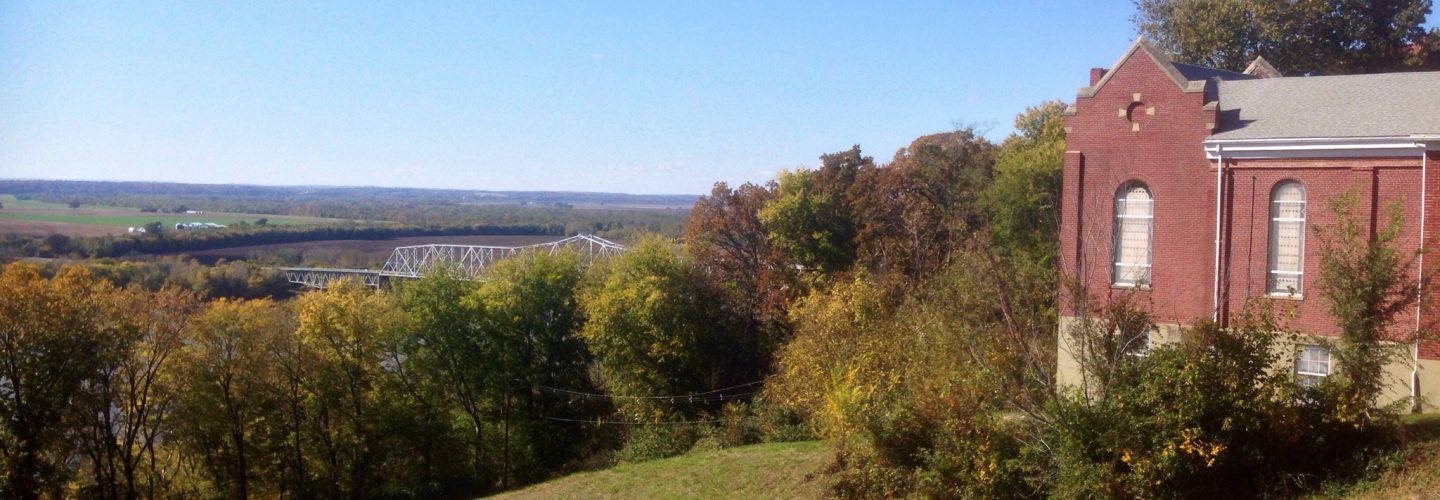

The Randolph Society Foundation Board is pleased to announce that the members of Randolph County’s Burlington Way Committee, pioneers in the field of automobile travel, will be inducted into the 2025 class of honorees.
At the turn of the 20th century, Randolph County’s citizens relied solely on horses, wagons, and trains for transportation along the county’s dirt and rock roads. But by 1901, automobiles began appearing on the streets of local towns. The first automobile dealership in the county was opened by the Herschbach Bros. of Chester in 1908, and buyers flocked to purchase the exciting new machines. Farmers, doctors, and mail carriers in particular found early reasons to buy automobiles, and town and county officials soon saw the need to adapt both laws and infrastructure to accommodate the new mode of travel.
The lack of paved roads caused particular difficulty, with weather problems frequently making heavily-traveled roads virtually impassable. By 1916, after the Good Roads Act provided new sources of federal funding for highways, the Illinois State Highway Agency also began the construction of nearly 5,000 miles of hard road highways across the state.
Various committees worked to decide routes that these new roads would take, and local communities lobbied to have the roads pass through their towns. Having a state highway nearby would be a boost to local motorists as well as the economy. But rural areas like Randolph County were often afterthoughts on the new maps. When the Chicago Tribune published a map of the state’s marked highways in 1916, Randolph County was one of the only ones not serviced by one of the new hard roads.
A group of local businessmen stepped in to try to remedy that oversight. One highway project in particular, the Burlington Way, was looking to extend from St. Paul, Minnesota, south to the Gulf of Mexico. An established section of the road stopped in Marissa, and the Randolph County committee lobbied to have the next part of the highway travel through Sparta, Steeleville, and Percy on its way south to Murphysboro.
The county’s Burlington Way Committee was comprised of Charles Baue, a Steeleville farmer and mechanical engineer; Alfred A. Brown, a Sparta banker and merchant; William J. Hood, owner of a Sparta dry goods store; Louis Hood, owner of a Sparta clothing store; John B. Hoef, the founder of Steeleville’s Randolph County Monument Works; Henry Walter, a grocery store manager and food administrator from Steeleville; George Lickiss, the proprietor of a Percy grocery store; Albert Gilster, owner of the Steeleville flour mill; Rutherford Hahn, the vice president of Gilster’s mill; Norris Lessley, the president of Sparta State Bank; J. Hammond Webster, publisher of the Steeleville Ledger and owner of an auto garage; Robert Moffat, an owner of Sparta’s Moffat Coal Company; and Thomas Jeremiah, the general superintendent of the Willis Coal Company.
The committee successfully lobbied to have the Burlington Highway routed through Randolph County, though two decades later the route of the road, now Illinois 13, was changed. Their efforts are commemorated by a granite marker located on present-day Illinois 4 between Sparta and Steeleville. As the first committee dedicated to bringing a major highway through the county, they also inspired further movements to establish good roads in the region, pioneering projects that are still in use today.
Today, the issue of “good roads” continues to be at the top of the list for many in the area who want to steer attention toward the maintenance of existing roads and the expansion of highway connections between Randolph County and its neighbors. A century ago, when roads made for automobiles were in their infancy, we can thank the men of the Burlington Way Committee for championing the cause. Their public service is a reminder of the importance of community advocacy, both then and now.
Click here to read a more detailed biography of the members of the Burlington Way Committee.


 The Randolph Society