
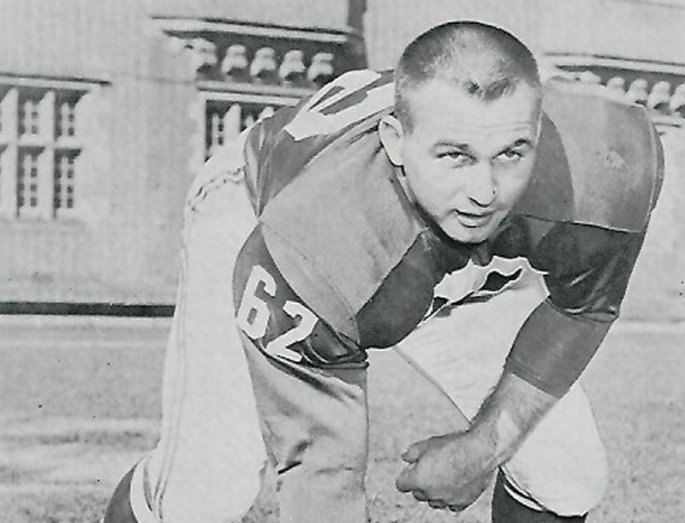
The Randolph Society Foundation Board is pleased to announce that John Wittenborn, a talented athlete who became a devoted coach and mentor, will be inducted into the 2024 class of honorees.
John Otis Wittenborn was born in Sparta on March 1, 1936. He was the fifth child of Raymond Wittenborn and Mabel Steffens Wittenborn, who both came from established Randolph County families. John was raised with six brothers and sisters on the family’s dairy farm near Sparta. Though he initially expected to follow in his father’s footsteps as a farmer, his innate athletic talent led him down a different path.
John began his stellar sports career at Sparta High School, playing football and basketball and running track. He was named to the All-Conference football team twice, and after graduating in 1955, he was recruited to play college football. John decided to continue both his education and his athletic career at Southeast Missouri State University in Cape Girardeau. During his four years on the team, he displayed excellence as both a tackle and a kicker. Despite injuries, he was a key part of several conference championship teams and was named an honorary co-captain in his senior season. In 2003, SEMO inducted him into their Athletic Hall of Fame.
Just weeks after the end of the 1957 college season, John was drafted by the San Francisco 49ers, part of an outstanding draft class that also included names like Alex Karras, Jim Taylor, and John Madden. Even as a rookie, his coaches in San Francisco identified him as a stand-out on the offensive line. The 6’1”, 230 lb. right guard played for several seasons with the 49ers, developing into a versatile player who could contribute in multiple roles.
In the middle of the 1960 season, John was traded to the Philadelphia Eagles. He arrived on the team in the midst of their remarkable championship-winning season. After losing only one game during the regular season, the Eagles defeated Vince Lombardi’s Green Bay Packers in the NFL championship game on the day after Christmas. More than 67,000 fans watched as John blocked on the offensive line during the contest, bringing home a victory and a significant player’s share bonus check.
John remained on the Eagles roster for two more seasons. He was acquired by the St. Louis Cardinals football team in 1963 but was sidelined by an injury. At the age of 28, John considered retirement. But a new opportunity appeared in the form of a contract with the Houston Oilers in 1964. During his tenure with Houston, he further developed his kicking skills. He was named as the team’s starting kicker in 1967, a role he held until yet another injury ended his career. He officially retired from professional football in January 1969.
Retirement opened a new door for John, who was hired as the football coach at Murphysboro High School later that year. He discovered a passion for mentorship, and the football program flourished under his leadership for several seasons. His success caught the eye of one of his former Oilers coaches, who hired him as an assistant coach at the University of Tulsa in 1973. He spent the next two decades in Oklahoma, coaching for several years at Tulsa before returning to high school coaching in nearby Mannford.
In the 1990s, John made the decision to move back to southern Illinois, where he could live the quiet rural life he preferred. Soon enough, though, his football career came full circle. In 2001, after a season coaching at Trico, he was tapped to serve as the head football coach at Sparta High School. At the age of 65, he had officially returned to the place where his career began. The school retired his football jersey in 2011.
John passed away in March 2016 at the age of 80. He was survived by his wife, Sharron, and his children, stepchildren, and grandchildren. He was also fondly remembered by the many athletes he played with, coached with, and mentored. NFL kicker Steve Cox, a Tulsa alum, remembered that John was not only a great coach but also “simply a great guy, any way you look at it.”
Click here to read a more detailed biography of John Wittenborn.
 The Randolph Society